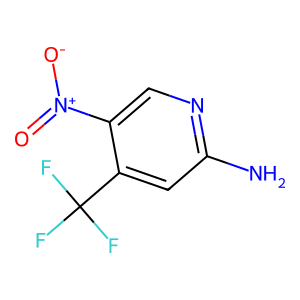
5-Nitro-4-(trifluoromethyl)pyridin-2-amine
CAS No.:
1000152-83-9
M. Wt:
207.11000
M. Fa:
C6H4F3N3O2
InChI Key:
WVKWPMZRKCPVKN-UHFFFAOYSA-N
Names and Identifiers of 1000152-83-9
CAS Number |
1000152-83-9 |
|---|---|
IUPAC Name |
5-nitro-4-(trifluoromethyl)pyridin-2-amine |
InChI |
InChI=1S/C6H4F3N3O2/c7-6(8,9)3-1-5(10)11-2-4(3)12(13)14/h1-2H,(H2,10,11) |
InChIKey |
WVKWPMZRKCPVKN-UHFFFAOYSA-N |
Canonical SMILES |
C1=C(C(=CN=C1N)[N+](=O)[O-])C(F)(F)F |
Physical and chemical properties of 1000152-83-9
Exact Mass |
207.02600 |
|---|---|
LogP |
2.69520 |
Molecular Formula |
C6H4F3N3O2 |
Molecular Weight |
207.11000 |
PSA |
84.73000 |
Applications of 1000152-83-9
5-Nitro-4-(trifluoromethyl)pyridin-2-amine has several potential applications:
- Pharmaceuticals: Due to its biological activity, it may serve as a lead compound in drug discovery efforts targeting various diseases.
- Agrochemicals: Its antimicrobial properties make it suitable for use in agricultural formulations.
- Materials Science: The compound could be utilized in developing new materials with specific electronic or optical properties.
Interaction Studies of 1000152-83-9
Interaction studies focusing on 5-nitro-4-(trifluoromethyl)pyridin-2-amine often explore its binding affinity and inhibitory effects on various biological targets:
- Protein-Ligand Interactions: Investigations into how this compound interacts with proteins involved in metabolic pathways can provide insights into its mechanism of action.
- Structure-Activity Relationship Studies: These studies help elucidate how modifications to the structure impact biological activity, guiding further synthetic efforts.
Biological Activity of 1000152-83-9
Research indicates that compounds similar to 5-nitro-4-(trifluoromethyl)pyridin-2-amine exhibit various biological activities, including:
- Antimicrobial Properties: Some derivatives demonstrate effectiveness against bacterial strains and fungi.
- Anticancer Activity: Certain studies suggest potential applications in cancer treatment due to their ability to inhibit specific cellular pathways.
- Enzyme Inhibition: Compounds in this class may act as inhibitors for enzymes involved in critical biological processes, making them candidates for drug development.
 Cas:106447-97-6
