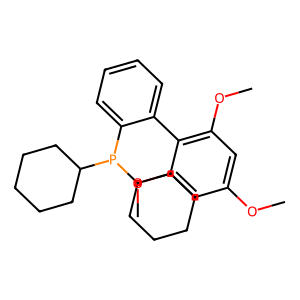
2'-Dicyclohexylphosphino-2,4,6-trimethoxybiphenyl
Names and Identifiers of 1000171-05-0
CAS Number |
1000171-05-0 |
|---|---|
EC Number |
631-191-4 |
IUPAC Name |
dicyclohexyl-[2-(2,4,6-trimethoxyphenyl)phenyl]phosphane |
InChI |
InChI=1S/C27H37O3P/c1-28-20-18-24(29-2)27(25(19-20)30-3)23-16-10-11-17-26(23)31(21-12-6-4-7-13-21)22-14-8-5-9-15-22/h10-11,16-19,21-22H,4-9,12-15H2,1-3H3 |
InChIKey |
NTHFAYYJLKWDAE-UHFFFAOYSA-N |
Canonical SMILES |
COC1=CC(=C(C(=C1)OC)C2=CC=CC=C2P(C3CCCCC3)C4CCCCC4)OC |
Physical and chemical properties of 1000171-05-0
Exact Mass |
440.24800 |
|---|---|
LogP |
7.15200 |
Molecular Formula |
C27H37O3P |
Molecular Weight |
440.55500 |
PSA |
41.28000 |
Safety Information of 1000171-05-0
Applications of 1000171-05-0
The primary applications of 2'-Dicyclohexylphosphino-2,4,6-trimethoxybiphenyl include:
- Catalysis: It is widely used as a ligand in palladium-catalyzed cross-coupling reactions due to its ability to stabilize palladium complexes and enhance reaction rates.
- Organic Synthesis: The compound serves as an important building block in synthesizing complex organic molecules and pharmaceuticals.
- Material Science: It may also find applications in developing advanced materials due to its unique electronic properties.
Interaction Studies of 1000171-05-0
Interaction studies involving 2'-Dicyclohexylphosphino-2,4,6-trimethoxybiphenyl typically focus on its behavior in catalytic systems. Research has indicated that this ligand can significantly influence the selectivity and efficiency of palladium-catalyzed reactions. For instance, studies have demonstrated that varying the electronic properties of ligands can lead to substantial changes in catalytic performance.
Biological Activity of 1000171-05-0
While specific biological activities for 2'-Dicyclohexylphosphino-2,4,6-trimethoxybiphenyl are not extensively documented, its derivatives and related phosphine ligands have been studied for potential applications in medicinal chemistry. For instance, some phosphine ligands have shown promise in developing inhibitors for various biological targets, including enzymes involved in metabolic diseases.