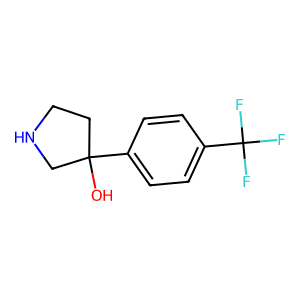
3-(4-(Trifluoromethyl)phenyl)pyrrolidin-3-ol
Names and Identifiers of 1000198-74-2
CAS Number |
1000198-74-2 |
|---|---|
IUPAC Name |
3-[4-(trifluoromethyl)phenyl]pyrrolidin-3-ol |
InChI |
InChI=1S/C11H12F3NO/c12-11(13,14)9-3-1-8(2-4-9)10(16)5-6-15-7-10/h1-4,15-16H,5-7H2 |
InChIKey |
YEOWRYUFQAXJOT-UHFFFAOYSA-N |
Canonical SMILES |
C1CNCC1(C2=CC=C(C=C2)C(F)(F)F)O |
Physical and chemical properties of 1000198-74-2
Acidity coefficient |
13.65±0.20(Predicted) |
|---|---|
Boiling Point |
262.5±40.0 °C at 760 mmHg |
Density |
1.3±0.1 g/cm3 |
Exact Mass |
231.087097 |
Flash Point |
112.6±27.3 °C |
Index of Refraction |
1.505 |
LogP |
0.91 |
Molecular Formula |
C11H12F3NO |
Molecular Weight |
231.214 |
PSA |
32.26000 |
Vapour Pressure |
0.0±0.6 mmHg at 25°C |
Applications of 1000198-74-2
3-(4-(Trifluoromethyl)phenyl)pyrrolidin-3-ol has diverse applications in various fields:
- Chemistry: It serves as a building block in the synthesis of more complex molecules.
- Biology: The compound is studied for its potential biological activities, including enzyme inhibition and receptor binding.
- Medicine: Research is ongoing to explore its therapeutic effects in treating various diseases.
- Industry: It is utilized in developing new materials and as a catalyst in
Interaction Studies of 1000198-74-2
Interaction studies are crucial for understanding the pharmacodynamics of 3-(4-(Trifluoromethyl)phenyl)pyrrolidin-3-ol. Investigations have shown that the trifluoromethyl group enhances binding affinity to specific biological targets, which could lead to improved therapeutic profiles compared to non-fluorinated counterparts. Further research is needed to elucidate specific interactions at the molecular level, potentially involving receptor binding assays or enzyme inhibition tests.
Biological Activity of 1000198-74-2
Research indicates that 3-(4-(Trifluoromethyl)phenyl)pyrrolidin-3-ol exhibits significant biological activity. Its mechanism of action involves interactions with specific molecular targets, such as enzymes and receptors, potentially leading to enzyme inhibition or receptor activation. The trifluoromethyl group enhances binding affinity to biological targets, which may improve therapeutic profiles compared to non-fluorinated analogs. Ongoing studies are investigating its effects on various biological pathways and its potential as a therapeutic agent for diseases.