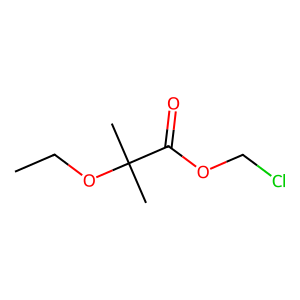
Chloromethyl 2-ethoxy-2-methylpropanoate
Names and Identifiers of 1000296-74-1
CAS Number |
1000296-74-1 |
|---|---|
IUPAC Name |
chloromethyl 2-ethoxy-2-methylpropanoate |
InChI |
InChI=1S/C7H13ClO3/c1-4-11-7(2,3)6(9)10-5-8/h4-5H2,1-3H3 |
InChIKey |
KODYUJRYYSLSBT-UHFFFAOYSA-N |
Canonical SMILES |
CCOC(C)(C)C(=O)OCCl |
Physical and chemical properties of 1000296-74-1
Boiling Point |
215℃ |
|---|---|
Density |
1.092 |
Exact Mass |
180.05500 |
Flash Point |
82℃ |
LogP |
1.54100 |
Molecular Formula |
C7H13ClO3 |
Molecular Weight |
180.62900 |
PSA |
35.53000 |
Applications of 1000296-74-1
Chloromethyl 2-ethoxy-2-methylpropanoate finds applications primarily in:
- Organic Synthesis: It serves as a key intermediate for synthesizing more complex organic molecules.
- Pharmaceutical Development: Its reactivity allows for modifications that can lead to biologically active compounds.
These applications underscore its importance in both academic research and industrial settings.
Interaction Studies of 1000296-74-1
Interaction studies involving chloromethyl 2-ethoxy-2-methylpropanoate focus on its reactivity with various nucleophiles and electrophiles. Understanding these interactions is crucial for predicting its behavior in synthetic pathways and potential biological implications. Specific studies may include:
- The reaction kinetics with amines or alcohols.
- The stability of the compound under different pH conditions and temperatures.
Such investigations can provide insights into optimizing its use in synthetic chemistry.
Biological Activity of 1000296-74-1
While specific biological activity data on chloromethyl 2-ethoxy-2-methylpropanoate is limited, compounds with similar structures often exhibit notable biological properties. For example, chloromethyl esters are generally known for their potential as intermediates in drug synthesis and their interactions with biological macromolecules. Further studies would be necessary to elucidate any specific biological activities associated with this compound.