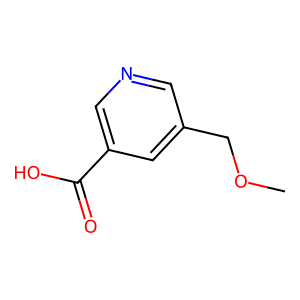
5-(Methoxymethyl)pyridine-3-carboxylic acid
CAS No.:
1000298-38-3
M. Wt:
167.1640015
M. Fa:
-
InChI Key:
HNOLVYVVGFTNMU-UHFFFAOYSA-N
Names and Identifiers of 1000298-38-3
CAS Number |
1000298-38-3 |
|---|---|
MDL Number |
MFCD18257073 |
IUPAC Name |
5-(methoxymethyl)pyridine-3-carboxylic acid |
InChI |
InChI=1S/C8H9NO3/c1-12-5-6-2-7(8(10)11)4-9-3-6/h2-4H,5H2,1H3,(H,10,11) |
InChIKey |
HNOLVYVVGFTNMU-UHFFFAOYSA-N |
Canonical SMILES |
COCC1=CC(=CN=C1)C(=O)O |
UNSPSC Code |
12352100 |
Physical and chemical properties of 1000298-38-3
H Bond Acceptors |
4 |
|---|---|
H Bond Donors |
1 |
LogP |
-0.514870570633547 |
Molecular Weight |
167.1640015 |
Safety Information of 1000298-38-3

Applications of 1000298-38-3
5-(Methoxymethyl)pyridine-3-carboxylic acid finds applications in various fields:
- Pharmaceuticals: Its derivatives are explored as potential drugs due to their biological activities.
- Agricultural Chemicals: It may serve as a precursor for developing herbicides or pesticides.
- Chemical Synthesis: The compound acts as an intermediate in synthesizing more complex organic molecules.
Interaction Studies of 1000298-38-3
Studies on the interactions of 5-(methoxymethyl)pyridine-3-carboxylic acid with biological targets are crucial for understanding its potential therapeutic roles. Research has indicated:
- Enzyme Inhibition: Some derivatives may inhibit specific enzymes involved in disease pathways, providing insights into their mechanisms of action.
- Receptor Binding: Investigations into how these compounds bind to receptors can reveal their pharmacological profiles and therapeutic potentials.
Biological Activity of 1000298-38-3
5-(Methoxymethyl)pyridine-3-carboxylic acid exhibits various biological activities due to its structural characteristics. Research indicates that compounds containing pyridine rings often demonstrate:
- Antimicrobial Properties: Many pyridine derivatives show efficacy against bacterial and fungal strains.
- Anti-inflammatory Effects: Some studies suggest potential anti-inflammatory activity, making it a candidate for therapeutic applications.
- Cytotoxicity: Certain derivatives have been investigated for their ability to induce apoptosis in cancer cells, highlighting their potential in oncology.