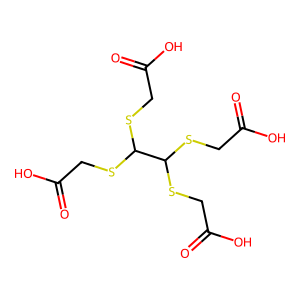
(ETHANEDIYLIDENETETRATHIO)TETRAACETIC ACID
Names and Identifiers of 10003-69-7
CAS Number |
10003-69-7 |
|---|---|
IUPAC Name |
2-[1,2,2-tris(2-hydroxy-2-oxoethylsulfanyl)ethylsulfanyl]ethanoic acid |
Canonical SMILES |
C(C(=O)O)SC(C(SCC(=O)O)SCC(=O)O)SCC(=O)O |
Physical and chemical properties of 10003-69-7
Boiling Point |
777.7ºC at 760mmHg |
|---|---|
Density |
1.707g/cm3 |
Exact Mass |
389.95700 |
Flash Point |
424.2ºC |
Index of Refraction |
1.681 |
LogP |
0.90980 |
Melting Point |
196-201ºC |
Molecular Formula |
C10H14O8S4 |
Molecular Weight |
390.47300 |
PSA |
250.40000 |
Vapour Pressure |
1.65E-26mmHg at 25°C |
Safety Information of 10003-69-7

Applications of 10003-69-7
Interaction Studies of 10003-69-7
Interaction studies involving (ethanediylidenetetraphio)tetraacetic acid primarily focus on its compatibility with other chemical agents and its efficacy in various environments. Research has shown that this compound retains its chelation ability even when mixed with other substances, such as sodium hypochlorite, indicating potential for combined therapeutic applications without compromising efficacy.
Moreover, studies indicate that while it effectively binds calcium ions, its interactions with other ions can vary significantly based on concentration and environmental conditions.
Biological Activity of 10003-69-7
(Ethanediylidenetetraphio)tetraacetic acid exhibits notable biological activity due to its chelating properties. It has been investigated for its potential use in detoxifying heavy metals from biological systems. By binding to toxic metal ions, it facilitates their excretion from the body. Additionally, studies suggest that this compound may have antioxidant properties, providing protection against oxidative stress in cellular environments.