
1-(4-Methyl-2-nitrophenyl)hydrazine hydrochloride
CAS No.:
100032-76-6
M. Wt:
203.626
M. Fa:
C7H10ClN3O2
InChI Key:
CXNLYIUEYAZYRD-UHFFFAOYSA-N
Names and Identifiers of 100032-76-6
CAS Number |
100032-76-6 |
|---|---|
MDL Number |
MFCD04966809 |
IUPAC Name |
(4-methyl-2-nitrophenyl)hydrazine;hydrochloride |
InChI |
InChI=1S/C7H9N3O2.ClH/c1-5-2-3-6(9-8)7(4-5)10(11)12;/h2-4,9H,8H2,1H3;1H |
InChIKey |
CXNLYIUEYAZYRD-UHFFFAOYSA-N |
Canonical SMILES |
CC1=CC(=C(C=C1)NN)[N+](=O)[O-].Cl |
UNSPSC Code |
12352100 |
Physical and chemical properties of 100032-76-6
Exact Mass |
203.046158 |
|---|---|
H Bond Acceptors |
4 |
H Bond Donors |
2 |
LogP |
2.46829400433333 |
Molecular Formula |
C7H10ClN3O2 |
Molecular Weight |
203.626 |
Safety Information of 100032-76-6

Applications of 100032-76-6
1-(4-Methyl-2-nitrophenyl)hydrazine hydrochloride has several applications across different fields:
- Pharmaceuticals: It serves as an intermediate in the synthesis of various pharmaceutical compounds, particularly those targeting infectious diseases.
- Agricultural Chemicals: The compound may be utilized in developing agrochemicals due to its antimicrobial properties.
- Research Reagent: It is employed as a reagent in organic synthesis and research studies focused on enzyme inhibition and biological activity.
Interaction Studies of 100032-76-6
Interaction studies involving 1-(4-Methyl-2-nitrophenyl)hydrazine hydrochloride focus on its biochemical interactions:
- Protein Binding Studies: Research indicates that this compound can bind to certain proteins, influencing their activity and potentially leading to therapeutic effects.
- Metabolic Pathway Analysis: Investigations into how this compound affects metabolic pathways reveal insights into its mechanism of action and potential side effects.
Biological Activity of 100032-76-6
Research indicates that 1-(4-Methyl-2-nitrophenyl)hydrazine hydrochloride exhibits significant biological activity. Some key findings include:
- Antimicrobial Properties: Studies have shown that this compound possesses antimicrobial activity against various bacterial strains, making it a candidate for further development as an antibacterial agent.
- Antitumor Activity: Preliminary studies suggest that it may have antitumor effects, potentially due to its ability to induce apoptosis in cancer cells.
- Enzyme Inhibition: The compound has been investigated for its potential to inhibit specific enzymes involved in metabolic pathways, contributing to its therapeutic potential.
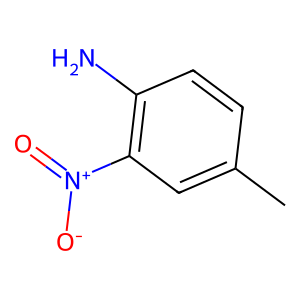 Cas:89-62-3
