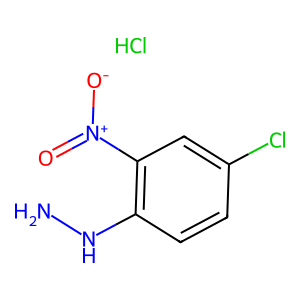
4-Chloro-2-nitrophenyl hydrazine hydrochloride
Names and Identifiers of 100032-77-7
CAS Number |
100032-77-7 |
|---|---|
IUPAC Name |
(4-chloro-2-nitrophenyl)hydrazine;hydrochloride |
InChI |
InChI=1S/C6H6ClN3O2.ClH/c7-4-1-2-5(9-8)6(3-4)10(11)12;/h1-3,9H,8H2;1H |
InChIKey |
LFBBZAYPJSLJCR-UHFFFAOYSA-N |
Canonical SMILES |
C1=CC(=C(C=C1Cl)[N+](=O)[O-])NN.Cl |
Physical and chemical properties of 100032-77-7
Exact Mass |
222.99200 |
|---|---|
LogP |
3.63230 |
Molecular Formula |
C6H7Cl2N3O2 |
Molecular Weight |
224.04500 |
PSA |
83.87000 |
Applications of 100032-77-7
4-Chloro-2-nitrophenyl hydrazine hydrochloride finds applications across various fields:
- Organic Synthesis: It serves as a reagent for synthesizing other organic compounds.
- Biochemical Research: The compound is used in studies investigating enzyme inhibition and antimicrobial properties.
- Pharmaceutical Development: Its biological activities make it a candidate for drug formulation and testing.
Interaction Studies of 100032-77-7
Studies on the interactions of 4-Chloro-2-nitrophenyl hydrazine hydrochloride with biological systems have revealed insights into its mechanism of action. For instance, it has been shown to interact with specific enzymes, potentially leading to inhibition or modification of their activity. This interaction can be critical for understanding its pharmacological potential and safety profile.
Biological Activity of 100032-77-7
Research indicates that 4-Chloro-2-nitrophenyl hydrazine hydrochloride exhibits notable biological activities. It has been studied for its potential as an antimicrobial agent and has shown effectiveness against certain bacterial strains. Additionally, it has been evaluated for its role in inhibiting specific enzymes, which could be relevant in drug development. Its biological properties make it a candidate for further pharmacological studies.
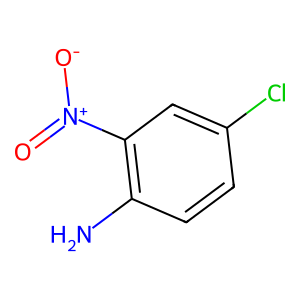 Cas:89-63-4
