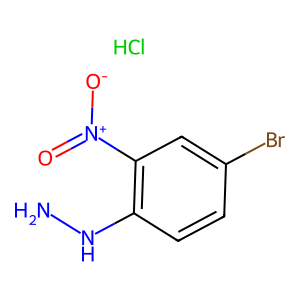
4-BROMO-2-NITROPHENYLHYDRAZINE HYDROCHLORIDE
CAS No.:
100032-79-9
M. Wt:
268.49600
M. Fa:
C6H7BrClN3O2
InChI Key:
-
Appearance:
Solid
Names and Identifiers of 100032-79-9
CAS Number |
100032-79-9 |
|---|---|
IUPAC Name |
(4-bromanyl-2-nitro-phenyl)diazane;hydrochloride |
Canonical SMILES |
C1=CC(=C(C=C1Br)[N+](=O)[O-])NN.Cl |
Physical and chemical properties of 100032-79-9
Exact Mass |
266.94100 |
|---|---|
LogP |
3.74140 |
Melting Point |
184-185ºC |
Molecular Formula |
C6H7BrClN3O2 |
Molecular Weight |
268.49600 |
PSA |
83.87000 |
Storage condition |
Keep Cold |
Safety Information of 100032-79-9

Applications of 100032-79-9
4-Bromo-2-nitrophenylhydrazine hydrochloride has several applications across different fields:
- Organic Synthesis: It serves as an intermediate in the synthesis of pharmaceuticals and agrochemicals.
- Analytical Chemistry: Used as a reagent for detecting carbonyl compounds through hydrazone formation.
- Research
Interaction Studies of 100032-79-9
Interaction studies involving 4-Bromo-2-nitrophenylhydrazine hydrochloride focus on its reactivity with various biological targets. Investigations have shown that it can interact with proteins and nucleic acids, potentially affecting their function. Studies assessing its binding affinity and mechanisms of action are crucial for understanding its biological implications .
Biological Activity of 100032-79-9
Research indicates that 4-Bromo-2-nitrophenylhydrazine hydrochloride exhibits biological activity that may include:
- Antimicrobial Properties: Some studies suggest potential effectiveness against certain bacteria and fungi.
- Antioxidant Activity: The compound may possess antioxidant properties, contributing to cellular protection against oxidative stress.
- Potential Cytotoxicity: There are indications that it may have cytotoxic effects on specific cancer cell lines, warranting further investigation into its therapeutic potential .
Physical sample testing spectrum (NMR) of 100032-79-9

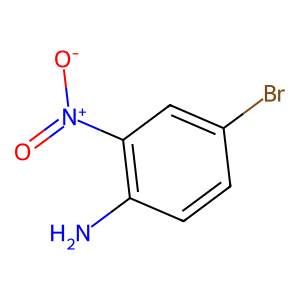 Cas:875-51-4
