
2-Methoxy-5-(4,4,5,5-tetramethyl-1,3,2-dioxaborolan-2-YL)aniline
Names and Identifiers of 1000339-10-5
CAS Number |
1000339-10-5 |
|---|---|
MDL Number |
MFCD16996341 |
IUPAC Name |
2-methoxy-5-(4,4,5,5-tetramethyl-1,3,2-dioxaborolan-2-yl)aniline |
InChI |
InChI=1S/C13H20BNO3/c1-12(2)13(3,4)18-14(17-12)9-6-7-11(16-5)10(15)8-9/h6-8H,15H2,1-5H3 |
InChIKey |
SCONHACZFQZWPB-UHFFFAOYSA-N |
Canonical SMILES |
B1(OC(C(O1)(C)C)(C)C)C2=CC(=C(C=C2)OC)N |
UNSPSC Code |
12352100 |
Physical and chemical properties of 1000339-10-5
Boiling Point |
376.3±32.0°C at 760 mmHg |
|---|---|
Exact Mass |
249.15400 |
LogP |
2.15780 |
Molecular Formula |
C13H20BNO3 |
Molecular Weight |
249.11400 |
PSA |
53.71000 |
Storage condition |
under inert gas (nitrogen or Argon) at 2–8 °C |
Safety Information of 1000339-10-5

Applications of 1000339-10-5
The applications of 2-Methoxy-5-(4,4,5,5-tetramethyl-1,3,2-dioxaborolan-2-YL)aniline span various fields:
- Organic Synthesis: It serves as an important intermediate for synthesizing more complex organic molecules.
- Materials Science: The compound has been utilized in developing novel copolymers with specific optical and electrochemical properties.
- Pharmaceutical Chemistry: Its derivatives may play roles in drug design and development due to their structural characteristics.
Interaction Studies of 1000339-10-5
Interaction studies involving 2-Methoxy-5-(4,4,5,5-tetramethyl-1,3,2-dioxaborolan-2-YL)aniline focus on its reactivity with various substrates in synthetic pathways. The moisture sensitivity of this compound can affect its stability and reactivity; therefore, understanding its interactions under different environmental conditions is crucial for optimizing its use in
Biological Activity of 1000339-10-5
While specific biological activities of 2-Methoxy-5-(4,4,5,5-tetramethyl-1,3,2-dioxaborolan-2-YL)aniline are not extensively documented, similar compounds have shown potential pharmacological effects. For instance, derivatives containing boron have been explored for their roles in medicinal chemistry, particularly in the development of cholinergic drugs that target the cholinergic system. The unique structural features of this compound may influence its interaction with biological systems and its potential as a therapeutic agent.
Physical sample testing spectrum (NMR) of 1000339-10-5

 Cas:6358-77-6

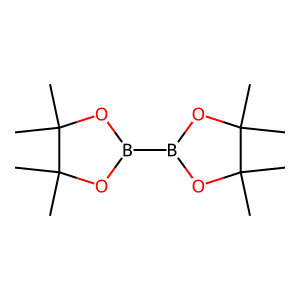 Cas:73183-34-3
