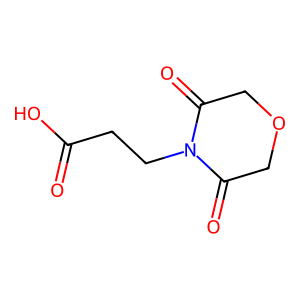
3-(3,5-Dioxomorpholin-4-yl)propanoic acid
CAS No.:
1000339-14-9
M. Wt:
187.150
M. Fa:
C7H9NO5
InChI Key:
NLPUMWSXDNXPMU-UHFFFAOYSA-N
Names and Identifiers of 1000339-14-9
CAS Number |
1000339-14-9 |
|---|---|
MDL Number |
MFCD11048470 |
IUPAC Name |
3-(3,5-dioxomorpholin-4-yl)propanoic acid |
InChI |
InChI=1S/C7H9NO5/c9-5-3-13-4-6(10)8(5)2-1-7(11)12/h1-4H2,(H,11,12) |
InChIKey |
NLPUMWSXDNXPMU-UHFFFAOYSA-N |
Canonical SMILES |
C1C(=O)N(C(=O)CO1)CCC(=O)O |
UNSPSC Code |
12352100 |
Physical and chemical properties of 1000339-14-9
Boiling Point |
471.3±40.0 °C at 760 mmHg |
|---|---|
Density |
1.4±0.1 g/cm3 |
Exact Mass |
187.048065 |
Flash Point |
238.8±27.3 °C |
Index of Refraction |
1.517 |
LogP |
-0.98 |
Molecular Formula |
C7H9NO5 |
Molecular Weight |
187.150 |
Vapour Pressure |
0.0±2.5 mmHg at 25°C |
Safety Information of 1000339-14-9

Applications of 1000339-14-9
This compound has potential applications in several areas:
- Pharmaceutical Development: Due to its biological activity, it may serve as a lead compound for developing new drugs.
- Biochemical Research: It is utilized in proteomics research to study protein interactions and functions.
- Agricultural Chemistry: Its antimicrobial properties could be explored for developing new agrochemicals.
Interaction Studies of 1000339-14-9
Studies on the interactions of 3-(3,5-Dioxomorpholin-4-yl)propanoic acid with biological macromolecules are crucial for understanding its mechanism of action. Research has focused on:
- Protein Binding Studies: Investigating how this compound interacts with proteins can reveal its potential targets within biological systems.
- Metabolic Pathway Analysis: Understanding how it influences metabolic pathways can provide insights into its therapeutic potential.
Biological Activity of 1000339-14-9
Research indicates that 3-(3,5-Dioxomorpholin-4-yl)propanoic acid exhibits various biological activities, including:
- Antimicrobial Properties: It has shown effectiveness against certain bacterial strains.
- Anti-inflammatory Effects: Preliminary studies suggest potential anti-inflammatory activities, making it a candidate for further pharmacological exploration.
- Enzyme Inhibition: There is evidence that this compound may inhibit specific enzymes involved in metabolic pathways, which could have therapeutic implications.