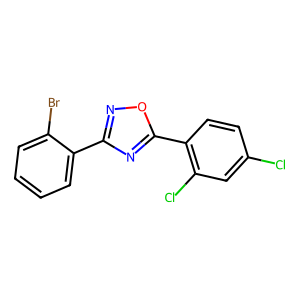
3-(2-Bromophenyl)-5-(2,4-dichlorophenyl)-1,2,4-oxadiazole
CAS No.:
1000339-26-3
M. Wt:
370.02800
M. Fa:
C14H7BrCl2N2O
InChI Key:
MSJONQGCEQKHBO-UHFFFAOYSA-N
Names and Identifiers of 1000339-26-3
CAS Number |
1000339-26-3 |
|---|---|
IUPAC Name |
3-(2-bromophenyl)-5-(2,4-dichlorophenyl)-1,2,4-oxadiazole |
InChI |
InChI=1S/C14H7BrCl2N2O/c15-11-4-2-1-3-9(11)13-18-14(20-19-13)10-6-5-8(16)7-12(10)17/h1-7H |
InChIKey |
MSJONQGCEQKHBO-UHFFFAOYSA-N |
Canonical SMILES |
C1=CC=C(C(=C1)C2=NOC(=N2)C3=C(C=C(C=C3)Cl)Cl)Br |
Physical and chemical properties of 1000339-26-3
Exact Mass |
367.91200 |
|---|---|
LogP |
5.47290 |
Molecular Formula |
C14H7BrCl2N2O |
Molecular Weight |
370.02800 |
PSA |
38.92000 |
Applications of 1000339-26-3
3-(2-Bromophenyl)-5-(2,4-dichlorophenyl)-1,2,4-oxadiazole has potential applications in:
- Pharmaceuticals: As a lead compound for developing new antimicrobial and anticancer agents.
- Materials Science: Due to its unique electronic properties, it may be used in organic electronics or as a fluorescent probe.
- Agriculture: Potential use as a pesticide or herbicide due to its biological activity against pathogens.
Interaction Studies of 1000339-26-3
Interaction studies involving 3-(2-Bromophenyl)-5-(2,4-dichlorophenyl)-1,2,4-oxadiazole focus on its binding affinity to various biological targets. These studies help elucidate its mechanism of action and potential side effects. Techniques such as molecular docking simulations and enzyme kinetics assays are commonly employed to assess these interactions.
Biological Activity of 1000339-26-3
Compounds containing the oxadiazole scaffold have been extensively studied for their biological activities. Research indicates that 3-(2-Bromophenyl)-5-(2,4-dichlorophenyl)-1,2,4-oxadiazole exhibits potential:
- Antimicrobial Activity: Some studies suggest that oxadiazole derivatives can inhibit bacterial growth, making them candidates for antibiotic development.
- Anticancer Properties: Certain derivatives have shown efficacy against various cancer cell lines by targeting specific pathways involved in cell proliferation and survival.
- Enzyme Inhibition: Oxadiazoles have been reported to inhibit enzymes such as carbonic anhydrase and histone deacetylases, which play crucial roles in cancer and inflammatory diseases.