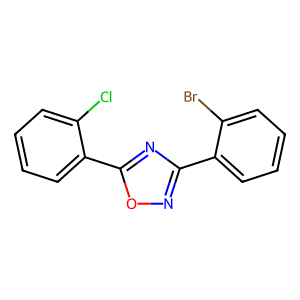
3-(2-Bromophenyl)-5-(2-chlorophenyl)-1,2,4-oxadiazole
Names and Identifiers of 1000339-28-5
CAS Number |
1000339-28-5 |
|---|---|
IUPAC Name |
3-(2-bromophenyl)-5-(2-chlorophenyl)-1,2,4-oxadiazole |
Canonical SMILES |
C1=CC=C(C(=C1)C2=NC(=NO2)C3=CC=CC=C3Br)Cl |
Physical and chemical properties of 1000339-28-5
Exact Mass |
333.95100 |
|---|---|
LogP |
4.81950 |
Molecular Formula |
C14H8BrClN2O |
Molecular Weight |
335.58300 |
PSA |
38.92000 |
Applications of 1000339-28-5
3-(2-Bromophenyl)-5-(2-chlorophenyl)-1,2,4-oxadiazole has potential applications in various fields:
- Medicinal Chemistry: It serves as a lead compound for developing new antibacterial and anticancer agents.
- Material Science: Due to its unique electronic properties, it may be explored for use in organic electronics or photonic devices.
- Agricultural Chemistry: Its biological activity suggests potential applications as a pesticide or fungicide.
Interaction Studies of 1000339-28-5
Interaction studies have focused on understanding how 3-(2-Bromophenyl)-5-(2-chlorophenyl)-1,2,4-oxadiazole interacts with biological targets. Molecular docking studies indicate that this compound may bind effectively to specific proteins involved in cancer pathways, enhancing its potential as an anticancer agent. Additionally, studies have shown that structural modifications can significantly influence its binding affinity and biological efficacy.
Biological Activity of 1000339-28-5
The biological activity of 3-(2-Bromophenyl)-5-(2-chlorophenyl)-1,2,4-oxadiazole has been explored in various studies. Compounds containing oxadiazole moieties are known for their antibacterial, antifungal, and anticancer properties. Specifically, this compound has shown promising results in inhibiting bacterial growth against both Gram-positive and Gram-negative strains. The presence of halogen substituents is believed to enhance its biological activity by increasing lipophilicity and altering electronic properties.