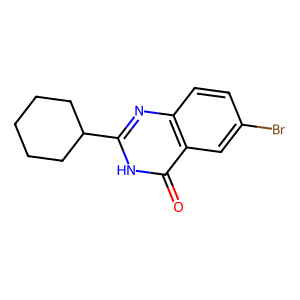
6-Bromo-2-cyclohexylquinazolin-4(3H)-one
CAS No.:
1000339-29-6
M. Wt:
307.18600
M. Fa:
C14H15BrN2O
InChI Key:
-
Names and Identifiers of 1000339-29-6
CAS Number |
1000339-29-6 |
|---|---|
IUPAC Name |
6-bromanyl-2-cyclohexyl-3H-quinazolin-4-one |
Canonical SMILES |
C1CCC(CC1)C2=NC3=C(C=C(C=C3)Br)C(=O)N2 |
Physical and chemical properties of 1000339-29-6
Exact Mass |
306.03700 |
|---|---|
LogP |
3.73330 |
Molecular Formula |
C14H15BrN2O |
Molecular Weight |
307.18600 |
PSA |
45.75000 |
Storage condition |
2-8°C |
Applications of 1000339-29-6
6-Bromo-2-cyclohexylquinazolin-4(3H)-one has potential applications in:
- Pharmaceutical Development: Due to its biological activities, it could serve as a lead compound for developing new antimicrobial or anticancer drugs.
- Chemical Research: It may be used as an intermediate in the synthesis of more complex heterocyclic compounds.
- Material Science: Investigations into its properties may reveal applications in organic electronics or photonic devices.
Interaction Studies of 1000339-29-6
Interaction studies involving 6-bromo-2-cyclohexylquinazolin-4(3H)-one focus on its binding affinity to various biological targets, including enzymes and receptors. These studies typically employ techniques such as:
- Molecular Docking: To predict how the compound interacts with specific proteins involved in disease pathways.
- In Vitro Assays: To evaluate its effectiveness against cultured cells or microbial strains.
Understanding these interactions is crucial for elucidating the compound's mechanism of action and potential therapeutic uses.
Biological Activity of 1000339-29-6
Quinazolinone derivatives, including 6-bromo-2-cyclohexylquinazolin-4(3H)-one, have shown promising biological activities. They are known for:
- Antimicrobial Activity: Studies indicate that quinazolinones exhibit antibacterial properties against various pathogens .
- Anticancer Properties: Some derivatives have been investigated for their ability to inhibit cancer cell proliferation and induce apoptosis .
- Anti-inflammatory Effects: Certain compounds in this class have demonstrated potential in reducing inflammation in experimental models.
The specific biological activity of 6-bromo-2-cyclohexylquinazolin-4(3H)-one would require empirical testing to establish its efficacy and mechanism of action.