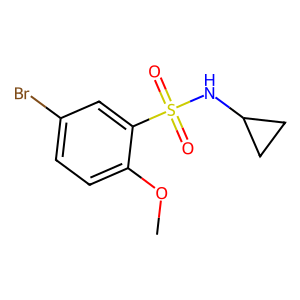
5-BROMO-N-CYCLOPROPYL-2-METHOXYBENZENESULFONAMIDE
Names and Identifiers of 1000339-35-4
CAS Number |
1000339-35-4 |
|---|---|
MDL Number |
MFCD08235093 |
IUPAC Name |
5-bromo-N-cyclopropyl-2-methoxybenzene-1-sulfonamide |
InChI |
InChI=1S/C10H12BrNO3S/c1-15-9-5-2-7(11)6-10(9)16(13,14)12-8-3-4-8/h2,5-6,8,12H,3-4H2,1H3 |
InChIKey |
UMVXZMYOHRGQIY-UHFFFAOYSA-N |
Canonical SMILES |
COC1=CC=C(Br)C=C1S(=O)(=O)NC1CC1 |
UNSPSC Code |
12352100 |
Physical and chemical properties of 1000339-35-4
Boiling Point |
428.9±55.0 °C at 760 mmHg |
|---|---|
Density |
1.7±0.1 g/cm3 |
Exact Mass |
304.972107 |
Flash Point |
213.2±31.5 °C |
H Bond Acceptors |
3 |
H Bond Donors |
1 |
Index of Refraction |
1.626 |
LogP |
2.65 |
Molecular Formula |
C10H12BrNO3S |
Molecular Weight |
306.176 |
Vapour Pressure |
0.0±1.0 mmHg at 25°C |
Safety Information of 1000339-35-4

Applications of 1000339-35-4
5-Bromo-N-cyclopropyl-2-methoxybenzenesulfonamide has potential applications in pharmaceuticals due to its biological activity. It may serve as a lead compound for developing new antibacterial agents or anticancer drugs. Furthermore, its chemical properties make it suitable for use in research settings focused on enzyme inhibition and drug design.
Interaction Studies of 1000339-35-4
Interaction studies involving 5-bromo-N-cyclopropyl-2-methoxybenzenesulfonamide are crucial for understanding its pharmacodynamics and pharmacokinetics. Preliminary studies suggest that it may interact with various biological targets, particularly ribonucleotide reductase. These interactions could lead to significant therapeutic effects but also necessitate further research to assess potential side effects and toxicity profiles.
Biological Activity of 1000339-35-4
Sulfonamide compounds, including 5-bromo-N-cyclopropyl-2-methoxybenzenesulfonamide, have been studied for their potential biological activities. They often exhibit antibacterial properties by inhibiting bacterial folate synthesis. Additionally, this specific compound has shown promise as an inhibitor of ribonucleotide reductase, an enzyme crucial for DNA synthesis, indicating potential applications in cancer therapy. Further investigations are necessary to elucidate its full spectrum of biological effects.
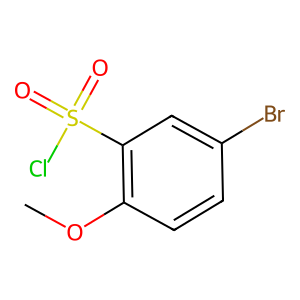 Cas:23095-05-8

 Cas:765-30-0
