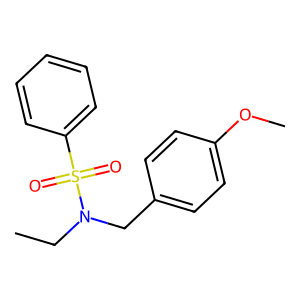
N-Ethyl-N-(4-methoxybenzyl)benzenesulphonamide
CAS No.:
1000339-36-5
M. Wt:
305.39200
M. Fa:
C16H19NO3S
InChI Key:
FPJRJXFBGCSTSH-UHFFFAOYSA-N
Names and Identifiers of 1000339-36-5
CAS Number |
1000339-36-5 |
|---|---|
MDL Number |
MFCD09878415 |
IUPAC Name |
N-ethyl-N-[(4-methoxyphenyl)methyl]benzenesulfonamide |
InChI |
InChI=1S/C16H19NO3S/c1-3-17(13-14-9-11-15(20-2)12-10-14)21(18,19)16-7-5-4-6-8-16/h4-12H,3,13H2,1-2H3 |
InChIKey |
FPJRJXFBGCSTSH-UHFFFAOYSA-N |
Canonical SMILES |
CCN(CC1=CC=C(OC)C=C1)S(=O)(=O)C1=CC=CC=C1 |
UNSPSC Code |
12352100 |
Physical and chemical properties of 1000339-36-5
Exact Mass |
305.10900 |
|---|---|
H Bond Acceptors |
3 |
H Bond Donors |
0 |
LogP |
3.98680 |
Molecular Formula |
C16H19NO3S |
Molecular Weight |
305.39200 |
PSA |
54.99000 |
Safety Information of 1000339-36-5

Applications of 1000339-36-5
N-Ethyl-N-(4-methoxybenzyl)benzenesulfonamide has potential applications in various fields:
- Pharmaceuticals: Due to its biological activity, it may serve as a lead compound for developing new antimicrobial or antiviral drugs.
- Chemical Research: It can be used as a building block in organic synthesis for creating more complex molecules.
- Agricultural Chemicals: Its properties may be explored for use in developing agrochemicals.
Interaction Studies of 1000339-36-5
Studies investigating the interactions of N-Ethyl-N-(4-methoxybenzyl)benzenesulfonamide with biological targets have shown that:
- The compound can interact with specific enzymes involved in metabolic pathways, potentially leading to inhibition or modulation of these pathways.
- Structure-activity relationship (SAR) studies highlight how variations in substituents affect binding affinity and biological efficacy.
Biological Activity of 1000339-36-5
Benzenesulfonamides, including N-Ethyl-N-(4-methoxybenzyl)benzenesulfonamide, exhibit a range of biological activities:
- Antimicrobial Properties: Many sulfonamides are known for their antibacterial effects, particularly against Gram-positive bacteria.
- Antiviral Activity: Research indicates that modifications in the structure of benzenesulfonamides can enhance their antiviral properties, making them potential candidates for treating viral infections.
- Carbonic Anhydrase Inhibition: Some derivatives have shown promise as inhibitors of carbonic anhydrase, which is relevant in treating conditions like glaucoma and epilepsy.