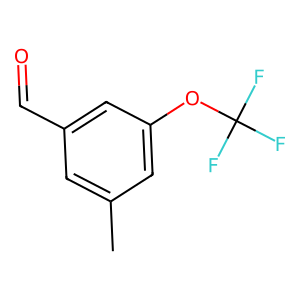
3-Methyl-5-(trifluoromethoxy)benzaldehyde
CAS No.:
1000339-55-8
M. Wt:
204.14600
M. Fa:
C9H7F3O2
InChI Key:
LAGVGNCAIJDRHK-UHFFFAOYSA-N
Names and Identifiers of 1000339-55-8
CAS Number |
1000339-55-8 |
|---|---|
MDL Number |
MFCD08741401 |
IUPAC Name |
3-methyl-5-(trifluoromethoxy)benzaldehyde |
InChI |
InChI=1S/C9H7F3O2/c1-6-2-7(5-13)4-8(3-6)14-9(10,11)12/h2-5H,1H3 |
InChIKey |
LAGVGNCAIJDRHK-UHFFFAOYSA-N |
Canonical SMILES |
CC1=CC(=CC(=C1)OC(F)(F)F)C=O |
UNSPSC Code |
12352100 |
Physical and chemical properties of 1000339-55-8
Exact Mass |
204.04000 |
|---|---|
Index of Refraction |
1.4590 |
LogP |
2.70610 |
Molecular Formula |
C9H7F3O2 |
Molecular Weight |
204.14600 |
PSA |
26.30000 |
Sensitivity |
Air Sensitive |
Storage condition |
2-8°C |
Safety Information of 1000339-55-8

Applications of 1000339-55-8
The applications of 3-Methyl-5-(trifluoromethoxy)benzaldehyde are diverse:
- Pharmaceutical Industry: It serves as a key intermediate in the synthesis of novel pharmaceutical agents, particularly those targeting cancer and metabolic disorders.
- Agricultural Chemicals: The compound may be employed in developing agrochemicals due to its potential herbicidal or fungicidal properties.
- Material Science: Its unique electronic properties make it suitable for use in advanced materials and coatings.
Interaction Studies of 1000339-55-8
Interaction studies involving 3-Methyl-5-(trifluoromethoxy)benzaldehyde are essential for understanding its reactivity and potential biological effects:
- Protein Binding Studies: Investigating how this compound interacts with various proteins can provide insights into its mechanism of action in biological systems.
- Metabolic Pathway Analysis: Understanding how this compound is metabolized can help predict its efficacy and safety profile in therapeutic applications.