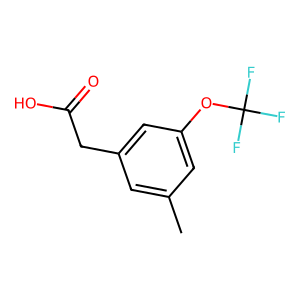
3-METHYL-5-(TRIFLUOROMETHOXY)PHENYLACETIC ACID
Names and Identifiers of 1000339-57-0
CAS Number |
1000339-57-0 |
|---|---|
MDL Number |
MFCD08741405 |
IUPAC Name |
2-[3-methyl-5-(trifluoromethoxy)phenyl]acetic acid |
InChI |
InChI=1S/C10H9F3O3/c1-6-2-7(5-9(14)15)4-8(3-6)16-10(11,12)13/h2-4H,5H2,1H3,(H,14,15) |
InChIKey |
VEEJCMLHVUBOPJ-UHFFFAOYSA-N |
Canonical SMILES |
CC1=CC(CC(=O)O)=CC(OC(F)(F)F)=C1 |
UNSPSC Code |
12352100 |
Physical and chemical properties of 1000339-57-0
Exact Mass |
234.05000 |
|---|---|
LogP |
2.52070 |
Melting Point |
52 to 56°C |
Molecular Formula |
C10H9F3O3 |
Molecular Weight |
234.17200 |
PSA |
46.53000 |
Safety Information of 1000339-57-0

Applications of 1000339-57-0
3-Methyl-5-(trifluoromethoxy)phenylacetic acid has potential applications in medicinal chemistry, particularly in designing drugs targeting metabolic disorders such as type 2 diabetes. Its structural features suggest it could be used in developing new GPR40 agonists that enhance insulin secretion and improve glucose tolerance . Additionally, due to its ability to cross the blood-brain barrier, it may have applications in neuropharmacology.
Interaction Studies of 1000339-57-0
Interaction studies involving 3-Methyl-5-(trifluoromethoxy)phenylacetic acid focus on its binding affinity to various receptors and enzymes relevant to metabolic pathways. Preliminary studies suggest that this compound may interact with GPR40 receptors, influencing insulin signaling pathways and glucose homeostasis . Further research is needed to delineate its complete interaction profile and therapeutic potential.
Biological Activity of 1000339-57-0
Research indicates that compounds similar to 3-Methyl-5-(trifluoromethoxy)phenylacetic acid exhibit significant biological activities, particularly as GPR40 agonists. These compounds have been studied for their potential in improving glucose metabolism and insulin sensitivity. The presence of the trifluoromethoxy group may enhance binding affinity to biological targets, making this compound a candidate for further investigation in metabolic disease therapies .