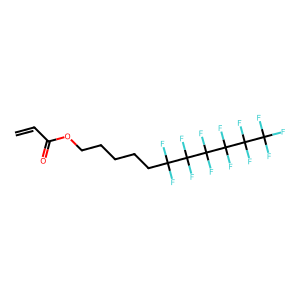
6,6,7,7,8,8,9,9,10,10,11,11,11-tridecafluoroundecyl prop-2-enoate
CAS No.:
1000339-61-6
M. Wt:
460.23
M. Fa:
C14H13F13O2
InChI Key:
-
Names and Identifiers of 1000339-61-6
CAS Number |
1000339-61-6 |
|---|---|
IUPAC Name |
6,6,7,7,8,8,9,9,10,10,11,11,11-tridecakis(fluoranyl)undecyl prop-2-enoate |
Canonical SMILES |
C=CC(=O)OCCCCCC(C(C(C(C(C(F)(F)F)(F)F)(F)F)(F)F)(F)F)(F)F |
Physical and chemical properties of 1000339-61-6
Molecular Formula |
C14H13F13O2 |
|---|---|
Molecular Weight |
460.23 |
Safety Information of 1000339-61-6

Applications of 1000339-61-6
1H,1H,2H,2H,3H,3H,4H,4H,5H,5H-Perfluoroundecyl acrylate has a wide range of applications due to its unique properties:
- Coatings: Used in protective coatings due to its low surface energy and resistance to chemicals and solvents.
- Membranes: Employed in separation membranes for gas or liquid filtration owing to its stability and permeability characteristics.
- Biomedical Devices: Investigated for potential use in medical devices where biocompatibility is essential .
- Self-cleaning Surfaces: Its low wettability makes it suitable for self-cleaning applications.
Interaction Studies of 1000339-61-6
Studies on the interactions of 1H,1H,2H,2H,3H,3H,4H,4H,5H,5H-Perfluoroundecyl acrylate with other substances have shown:
- Surface Interactions: The compound exhibits unique surface properties that influence adhesion and wettability when applied as a coating.
- Biocompatibility Assessments: Various studies have been conducted to evaluate how this compound interacts with biological tissues and fluids to determine its suitability for medical applications .
Biological Activity of 1000339-61-6
The biological activity of 1H,1H,2H,2H,3H,3H,4H,4H,5H,5H-Perfluoroundecyl acrylate has been explored primarily in terms of its toxicity and biocompatibility. Studies indicate that:
- It may cause skin irritation and allergic reactions upon contact .
- The compound's perfluorinated nature raises concerns regarding bioaccumulation and environmental persistence.
- Its use in biomedical applications requires careful assessment of its interactions with biological systems to ensure safety.