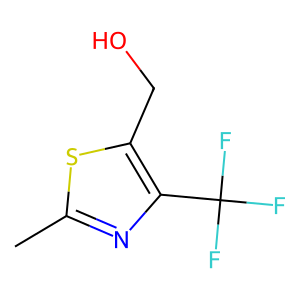
(2-Methyl-4-(trifluoromethyl)thiazol-5-yl)methanol
Names and Identifiers of 1000339-72-9
CAS Number |
1000339-72-9 |
|---|---|
MDL Number |
MFCD09264553 |
IUPAC Name |
[2-methyl-4-(trifluoromethyl)-1,3-thiazol-5-yl]methanol |
InChI |
InChI=1S/C6H6F3NOS/c1-3-10-5(6(7,8)9)4(2-11)12-3/h11H,2H2,1H3 |
InChIKey |
UUAQJWNNEXFILD-UHFFFAOYSA-N |
Canonical SMILES |
CC1=NC(=C(S1)CO)C(F)(F)F |
UNSPSC Code |
12352100 |
Physical and chemical properties of 1000339-72-9
Exact Mass |
197.01200 |
|---|---|
LogP |
1.96260 |
Melting Point |
83-85 |
Molecular Formula |
C6H6F3NOS |
Molecular Weight |
197.17800 |
PSA |
61.36000 |
Safety Information of 1000339-72-9

Applications of 1000339-72-9
(2-Methyl-4-(trifluoromethyl)thiazol-5-yl)methanol has several potential applications:
- Pharmaceuticals: Its antimicrobial properties make it a candidate for developing new antibiotics or antifungal agents.
- Agrochemicals: The compound may be used in agricultural formulations to protect crops from fungal infections.
- Chemical Intermediates: It serves as an important intermediate in synthesizing more complex thiazole derivatives with enhanced biological activities.
Interaction Studies of 1000339-72-9
Studies on the interactions of (2-Methyl-4-(trifluoromethyl)thiazol-5-yl)methanol with biological targets have indicated its potential effectiveness against specific enzymes and receptors involved in microbial resistance mechanisms. These interaction studies are crucial for understanding its mechanism of action and optimizing its use in therapeutic applications.
Biological Activity of 1000339-72-9
Research indicates that (2-Methyl-4-(trifluoromethyl)thiazol-5-yl)methanol exhibits notable biological activity. It has been studied for its potential antimicrobial and antifungal properties, making it a candidate for pharmaceutical development. The presence of the trifluoromethyl group enhances lipophilicity, which may improve bioavailability and efficacy against various pathogens.