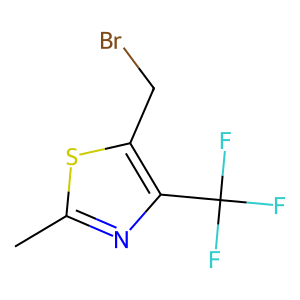
5-(Bromomethyl)-2-methyl-4-(trifluoromethyl)-1,3-thiazole
Names and Identifiers of 1000339-73-0
CAS Number |
1000339-73-0 |
|---|---|
MDL Number |
MFCD09264554 |
IUPAC Name |
5-(bromomethyl)-2-methyl-4-(trifluoromethyl)-1,3-thiazole |
InChI |
InChI=1S/C6H5BrF3NS/c1-3-11-5(6(8,9)10)4(2-7)12-3/h2H2,1H3 |
InChIKey |
OYDQGPCAYKWSAU-UHFFFAOYSA-N |
Canonical SMILES |
CC1=NC(C(F)(F)F)=C(CBr)S1 |
UNSPSC Code |
12352100 |
Physical and chemical properties of 1000339-73-0
Boiling Point |
225.867ºC at 760 mmHg |
|---|---|
Density |
1.718 g/cm3 |
Exact Mass |
258.92800 |
Flash Point |
90.401ºC |
LogP |
3.36520 |
Melting Point |
oil |
Molecular Formula |
C6H5BrF3NS |
Molecular Weight |
260.07500 |
PSA |
41.13000 |
Storage condition |
2-8°C |
Safety Information of 1000339-73-0

Applications of 1000339-73-0
The applications of 5-(Bromomethyl)-2-methyl-4-(trifluoromethyl)-1,3-thiazole span several fields:
- Pharmaceuticals: It serves as a building block for developing new drugs due to its biological activity.
- Agrochemicals: The compound may be utilized in the formulation of pesticides or herbicides.
- Material Science: Its unique properties could be harnessed in creating advanced materials or coatings.
Interaction Studies of 1000339-73-0
Interaction studies involving 5-(Bromomethyl)-2-methyl-4-(trifluoromethyl)-1,3-thiazole typically focus on its binding affinities with biological targets such as enzymes or receptors. These studies help elucidate its mechanism of action and potential therapeutic effects. For instance, thiazole derivatives are often investigated for their interactions with bacterial enzymes, which could lead to novel antibacterial agents.
Biological Activity of 1000339-73-0
5-(Bromomethyl)-2-methyl-4-(trifluoromethyl)-1,3-thiazole exhibits notable biological activities, particularly in the realm of medicinal chemistry. Research indicates that similar thiazole compounds can possess antimicrobial, antifungal, and anticancer properties. The trifluoromethyl group is known to enhance biological activity by increasing lipophilicity and metabolic stability.