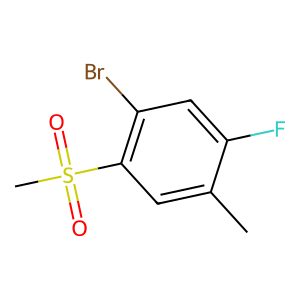
4-Bromo-2-fluoro-5-methylsulfonyltoluene
CAS No.:
1000339-74-1
M. Wt:
267.115
M. Fa:
C8H8BrFO2S
InChI Key:
DKCSMZJMLABZBI-UHFFFAOYSA-N
Names and Identifiers of 1000339-74-1
CAS Number |
1000339-74-1 |
|---|---|
MDL Number |
MFCD09264557 |
IUPAC Name |
1-bromo-5-fluoro-4-methyl-2-methylsulfonylbenzene |
InChI |
InChI=1S/C8H8BrFO2S/c1-5-3-8(13(2,11)12)6(9)4-7(5)10/h3-4H,1-2H3 |
InChIKey |
DKCSMZJMLABZBI-UHFFFAOYSA-N |
Canonical SMILES |
CC1=CC(=C(C=C1F)Br)S(=O)(=O)C |
UNSPSC Code |
12352100 |
Physical and chemical properties of 1000339-74-1
Boiling Point |
371.5±42.0 °C at 760 mmHg |
|---|---|
Density |
1.6±0.1 g/cm3 |
Exact Mass |
265.941223 |
Flash Point |
178.5±27.9 °C |
Index of Refraction |
1.540 |
LogP |
1.79 |
Melting Point |
92 to 94°C |
Molecular Formula |
C8H8BrFO2S |
Molecular Weight |
267.115 |
Vapour Pressure |
0.0±0.8 mmHg at 25°C |
Safety Information of 1000339-74-1

Applications of 1000339-74-1
4-Bromo-2-fluoro-5-methylsulfonyltoluene has potential applications in:
- Medicinal Chemistry: Its structure suggests that it may serve as a lead compound for developing new pharmaceuticals.
- Agricultural Chemicals: Compounds with similar functionalities are often explored as herbicides or pesticides.
- Research Reagents: It may be used as a reagent in organic synthesis or as a probe in proteomics research due to its unique chemical properties.
Interaction Studies of 1000339-74-1
Interaction studies involving 4-Bromo-2-fluoro-5-methylsulfonyltoluene could focus on:
- Protein Binding Studies: Understanding how this compound interacts with various proteins could elucidate its potential biological roles.
- Enzyme Inhibition: Assessing whether this compound inhibits specific enzymes could provide insights into its therapeutic potential.
Such studies would typically involve techniques such as affinity chromatography or surface plasmon resonance to quantify interactions.
Biological Activity of 1000339-74-1
While specific biological activity data for 4-Bromo-2-fluoro-5-methylsulfonyltoluene is limited, compounds with similar structures often exhibit significant biological properties. For instance, sulfonyl-containing compounds are known for their potential as pharmaceuticals due to their ability to interact with biological targets. Investigating such interactions could reveal potential applications in drug development or therapeutic uses.