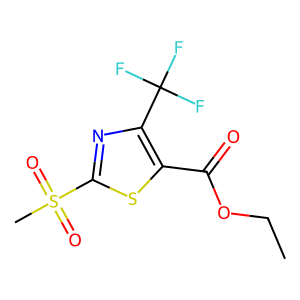
Ethyl 2-methylsulfonyl-4-trifluoromethyl-1,3-thiazole-5-carboxylate
CAS No.:
1000339-78-5
M. Wt:
303.28
M. Fa:
C8H8F3NO4S2
InChI Key:
NWECTZZKNWFTHO-UHFFFAOYSA-N
Appearance:
Solid
Names and Identifiers of 1000339-78-5
CAS Number |
1000339-78-5 |
|---|---|
MDL Number |
MFCD09750912 |
IUPAC Name |
ethyl 2-methylsulfonyl-4-(trifluoromethyl)-1,3-thiazole-5-carboxylate |
InChI |
InChI=1S/C8H8F3NO4S2/c1-3-16-6(13)4-5(8(9,10)11)12-7(17-4)18(2,14)15/h3H2,1-2H3 |
InChIKey |
NWECTZZKNWFTHO-UHFFFAOYSA-N |
Canonical SMILES |
CCOC(=O)C1=C(N=C(S1)S(=O)(=O)C)C(F)(F)F |
UNSPSC Code |
12352100 |
Physical and chemical properties of 1000339-78-5
Molecular Formula |
C8H8F3NO4S2 |
|---|---|
Molecular Weight |
303.28 |
Safety Information of 1000339-78-5

Applications of 1000339-78-5
Ethyl 2-methylsulfonyl-4-trifluoromethyl-1,3-thiazole-5-carboxylate has several applications across various fields:
- Pharmaceutical Development: It serves as a building block for synthesizing novel therapeutic agents targeting infectious diseases and cancers.
- Material Science: The compound is investigated for its potential in developing advanced materials, including polymers and coatings with specific properties due to its unique chemical structure.
- Agricultural Chemistry: Its antimicrobial properties make it a candidate for use in agricultural formulations aimed at pest control.
Interaction Studies of 1000339-78-5
Studies on Ethyl 2-methylsulfonyl-4-trifluoromethyl-1,3-thiazole-5-carboxylate reveal its interactions with various biological targets:
- Enzyme Binding Studies: Research has shown that this compound can bind to specific enzymes, inhibiting their activity and thereby influencing biochemical pathways.
- Receptor Interaction: The compound's structural features allow it to interact with certain receptors involved in disease processes, making it a candidate for drug development.
Biological Activity of 1000339-78-5
Research indicates that compounds similar to Ethyl 2-methylsulfonyl-4-trifluoromethyl-1,3-thiazole-5-carboxylate exhibit diverse biological activities, including:
- Antimicrobial Properties: Thiazole derivatives are known for their potential in combating bacterial and fungal infections.
- Anticancer Activity: Some studies suggest that such compounds may inhibit tumor growth and induce apoptosis in cancer cells.
- Enzyme Inhibition: The compound may interact with specific enzymes or receptors, modulating their activity, which is crucial for therapeutic applications.