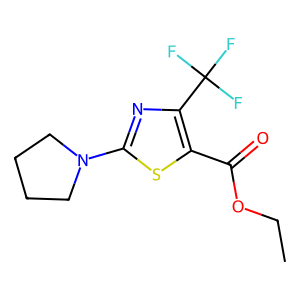
Ethyl 2-(Pyrrolidin-1-yl)-4-(trifluoromethyl)-1,3-thiazole-5-carboxylate
CAS No.:
1000339-79-6
M. Wt:
294.29300
M. Fa:
C11H13F3N2O2S
InChI Key:
UFCVXWWKIIUOGF-UHFFFAOYSA-N
Appearance:
Solid
Names and Identifiers of 1000339-79-6
CAS Number |
1000339-79-6 |
|---|---|
MDL Number |
MFCD09750913 |
IUPAC Name |
ethyl 2-pyrrolidin-1-yl-4-(trifluoromethyl)-1,3-thiazole-5-carboxylate |
InChI |
InChI=1S/C11H13F3N2O2S/c1-2-18-9(17)7-8(11(12,13)14)15-10(19-7)16-5-3-4-6-16/h2-6H2,1H3 |
InChIKey |
UFCVXWWKIIUOGF-UHFFFAOYSA-N |
Canonical SMILES |
CCOC(=O)C1=C(C(F)(F)F)N=C(N2CCCC2)S1 |
UNSPSC Code |
12352100 |
Physical and chemical properties of 1000339-79-6
Exact Mass |
294.06500 |
|---|---|
LogP |
3.00380 |
Molecular Formula |
C11H13F3N2O2S |
Molecular Weight |
294.29300 |
PSA |
70.67000 |
Safety Information of 1000339-79-6

Applications of 1000339-79-6
Ethyl 2-(pyrrolidin-1-yl)-4-trifluoromethyl-1,3-thiazole-5-carboxylate has several applications:
- Pharmaceutical Research: It serves as a scaffold in drug discovery for developing new therapeutic agents.
- Material Science: Its unique properties make it suitable for creating advanced materials with specific functionalities.
- Biochemical Studies: Utilized in enzyme inhibition studies and receptor binding assays.
Interaction Studies of 1000339-79-6
Interaction studies have focused on understanding how ethyl 2-(pyrrolidin-1-yl)-4-trifluoromethyl-1,3-thiazole-5-carboxylate interacts with biological targets:
- Molecular Docking Studies: These studies provide insights into binding affinities and modes of interaction with various enzymes.
- In Vitro Assays: Testing against microbial strains to evaluate antimicrobial efficacy and mechanism of action has yielded promising results.
Biological Activity of 1000339-79-6
Research indicates that ethyl 2-(pyrrolidin-1-yl)-4-trifluoromethyl-1,3-thiazole-5-carboxylate exhibits significant biological activities. It has been studied for its potential as:
- Antimicrobial Agent: Its structure suggests possible interactions with microbial enzymes.
- Enzyme Inhibitor: The presence of the pyrrolidine and thiazole rings may facilitate binding to active sites of various enzymes.
- Anti-inflammatory Properties: Preliminary studies suggest it may modulate inflammatory pathways, although further research is needed to confirm these effects.