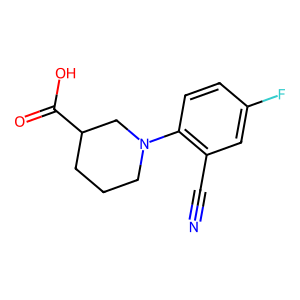
1-(2-Cyano-4-fluorophenyl)piperidine-3-carboxylic acid
Names and Identifiers of 1000339-80-9
CAS Number |
1000339-80-9 |
|---|---|
MDL Number |
MFCD09750917 |
IUPAC Name |
1-(2-cyano-4-fluorophenyl)piperidine-3-carboxylic acid |
InChI |
InChI=1S/C13H13FN2O2/c14-11-3-4-12(10(6-11)7-15)16-5-1-2-9(8-16)13(17)18/h3-4,6,9H,1-2,5,8H2,(H,17,18) |
InChIKey |
KTEZCPOWVJAFMP-UHFFFAOYSA-N |
Canonical SMILES |
C1CC(CN(C1)C2=C(C=C(C=C2)F)C#N)C(=O)O |
UNSPSC Code |
12352100 |
Physical and chemical properties of 1000339-80-9
Molecular Formula |
C13H13FN2O2 |
|---|---|
Molecular Weight |
248.25 |
Safety Information of 1000339-80-9

Applications of 1000339-80-9
This compound has several applications across various fields:
- Chemistry: It serves as a building block in synthesizing more complex molecules and as a reagent in organic reactions.
- Biological Research: The compound is investigated for its potential interactions with biological targets, contributing to drug discovery efforts.
- Industrial Use: It is utilized in developing new materials and as an intermediate in producing other chemical compounds.
Interaction Studies of 1000339-80-9
Studies on 1-(2-Cyano-4-fluorophenyl)piperidine-3-carboxylic acid's interactions with biological systems suggest it may influence enzyme activity or receptor binding. The exact mechanisms are still under investigation but are expected to involve specific molecular pathways that could lead to therapeutic effects.
Biological Activity of 1000339-80-9
Research indicates that 1-(2-Cyano-4-fluorophenyl)piperidine-3-carboxylic acid may exhibit significant biological activities. The presence of the cyano and fluorine groups enhances its binding affinity to various biological targets, including receptors and enzymes. The specific interactions depend on the context of its application, with ongoing studies exploring its potential therapeutic uses in pharmacology.