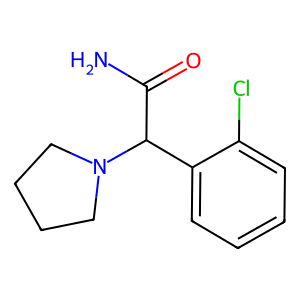
2-(2-Chlorophenyl)-2-(Pyrrolidin-1-Yl)Acetamide
CAS No.:
1000340-02-2
M. Wt:
238.71
M. Fa:
C12H15ClN2O
InChI Key:
IBDCMDIMPLMCLX-UHFFFAOYSA-N
Names and Identifiers of 1000340-02-2
CAS Number |
1000340-02-2 |
|---|---|
MDL Number |
MFCD09910404 |
IUPAC Name |
2-(2-chlorophenyl)-2-pyrrolidin-1-ylacetamide |
InChI |
InChI=1S/C12H15ClN2O/c13-10-6-2-1-5-9(10)11(12(14)16)15-7-3-4-8-15/h1-2,5-6,11H,3-4,7-8H2,(H2,14,16) |
InChIKey |
IBDCMDIMPLMCLX-UHFFFAOYSA-N |
Canonical SMILES |
NC(=O)C(C1=CC=CC=C1Cl)N1CCCC1 |
UNSPSC Code |
12352100 |
Physical and chemical properties of 1000340-02-2
Molecular Formula |
C12H15ClN2O |
|---|---|
Molecular Weight |
238.71 |
Safety Information of 1000340-02-2

Applications of 1000340-02-2
The potential applications of 2-(2-Chlorophenyl)-2-(pyrrolidin-1-YL)acetamide include:
- Pharmaceutical Development: Due to its biological activity, it may serve as a lead compound in the development of new medications targeting neurological disorders.
- Research Tool: It can be used in laboratory settings to study ion channel modulation and neurotransmitter dynamics.
Interaction Studies of 1000340-02-2
Interaction studies involving 2-(2-Chlorophenyl)-2-(pyrrolidin-1-YL)acetamide focus on its effects on various receptors and enzymes:
- Enzyme Inhibition: The compound has been evaluated for its inhibitory effects on monoamine oxidases (MAO-A and MAO-B), which are important in neurotransmitter metabolism .
- Receptor Binding Affinity: Studies have assessed its binding affinity to various neurotransmitter receptors, indicating potential therapeutic targets.
Biological Activity of 1000340-02-2
Research indicates that 2-(2-Chlorophenyl)-2-(pyrrolidin-1-YL)acetamide exhibits significant biological activity, particularly in modulating neurotransmitter systems. It has been studied for its potential as:
- Anticonvulsant Agent: The compound has shown promise in preclinical studies for its anticonvulsant properties, suggesting it may be effective in treating epilepsy or seizure disorders .
- Modulator of Ion Channels: Some studies have indicated that compounds with similar structures can act as modulators of potassium channels, which are crucial for neuronal excitability .