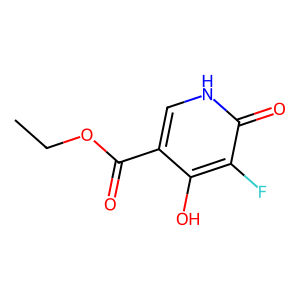
Ethyl 5-fluoro-4-hydroxy-6-oxo-1,6-dihydropyridine-3-carboxylate
Names and Identifiers of 1000340-08-8
CAS Number |
1000340-08-8 |
|---|---|
MDL Number |
MFCD09910417 |
IUPAC Name |
ethyl 5-fluoro-4-hydroxy-6-oxo-1H-pyridine-3-carboxylate |
InChI |
InChI=1S/C8H8FNO4/c1-2-14-8(13)4-3-10-7(12)5(9)6(4)11/h3H,2H2,1H3,(H2,10,11,12) |
InChIKey |
KRPFLIYEGCRSFO-UHFFFAOYSA-N |
Canonical SMILES |
CCOC(=O)C1=CNC(=O)C(=C1O)F |
UNSPSC Code |
12352100 |
Physical and chemical properties of 1000340-08-8
Acidity coefficient |
4.50±1.00(Predicted) |
|---|---|
Boiling Point |
280.5±40.0 °C(Predicted) |
Density |
1.44±0.1 g/cm3(Predicted) |
Exact Mass |
201.04400 |
LogP |
0.80860 |
Molecular Formula |
C8H8FNO4 |
Molecular Weight |
201.15200 |
PSA |
79.65000 |
Safety Information of 1000340-08-8

Applications of 1000340-08-8
Ethyl 5-fluoro-4-hydroxy-6-oxo-1,6-dihydropyridine-3-carboxylate has potential applications in:
- Pharmaceutical Development: As a building block for drug design targeting various diseases.
- Biochemical Research: Used as a reagent in assays and studies related to enzyme activity or metabolic pathways.
- Agricultural Chemistry: Potentially useful in developing agrochemicals due to its biological activity.
Interaction Studies of 1000340-08-8
Interaction studies involving ethyl 5-fluoro-4-hydroxy-6-oxo-1,6-dihydropyridine-3-carboxylate focus on its binding affinity with biological targets such as enzymes and receptors. These studies help elucidate the mechanism of action and therapeutic potential of the compound. Investigations may include:
- Molecular Docking Studies: To predict how the compound interacts with specific proteins or enzymes.
- In Vivo and In Vitro Studies: To assess biological effects in living organisms or cell cultures.
Several compounds share structural similarities with ethyl 5-fluoro-4-hydroxy-6-oxo-1,6-dihydropyridine-3-carboxylate. These include:
- Methyl 5-fluoro-4-hydroxy-6-oxo-pyridine-3-carboxylate
- Similar structure but with a methyl group instead of an ethyl group.
- Ethyl 4-hydroxyquinoline-3-carboxylate
- Contains a quinoline ring; may exhibit different biological activities.
- Ethyl 5-chloro-4-hydroxy-pyridine-3-carboxylate
- Contains a chlorine atom instead of fluorine; useful for comparing halogen effects on activity.
| Compound Name | Key Features | Biological Activity |
|---|---|---|
| Ethyl 5-fluoro-4-hydroxy-6-oxo-1,6-dihydropyridine | Fluorine substitution | Potential antimicrobial |
| Methyl 5-fluoro-4-hydroxy-6-oxo-pyridine | Methyl group instead of ethyl | Similar activity profile |
| Ethyl 4-hydroxyquinoline | Quinoline structure | Different mechanism |
| Ethyl 5-chloro-4-hydroxy-pyridine | Chlorine substitution | Varies from fluorinated |
Biological Activity of 1000340-08-8
Research indicates that compounds similar to ethyl 5-fluoro-4-hydroxy-6-oxo-1,6-dihydropyridine-3-carboxylate exhibit various biological activities, including:
- Antimicrobial Activity: Some derivatives have shown efficacy against bacterial strains.
- Antioxidant Properties: Compounds in this class may exhibit antioxidant effects, which are beneficial for reducing oxidative stress in biological systems.
- Potential Anticancer Activity: Preliminary studies suggest that modifications of the pyridine ring may lead to compounds with anticancer properties.
Further investigations are necessary to establish the specific biological activities of ethyl 5-fluoro-4-hydroxy-6-oxo-1,6-dihydropyridine-3-carboxylate.