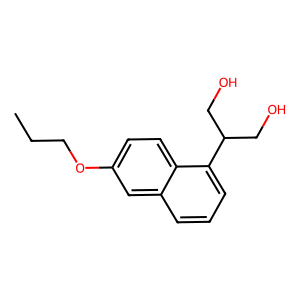
2-(6-Propoxynaphthalen-1-Yl)Propane-1,3-Diol
Names and Identifiers of 1000340-10-2
CAS Number |
1000340-10-2 |
|---|---|
MDL Number |
MFCD09910432 |
IUPAC Name |
2-(6-propoxynaphthalen-1-yl)propane-1,3-diol |
InChI |
InChI=1S/C16H20O3/c1-2-8-19-14-6-7-16-12(9-14)4-3-5-15(16)13(10-17)11-18/h3-7,9,13,17-18H,2,8,10-11H2,1H3 |
InChIKey |
DSGHIEYBWHROTQ-UHFFFAOYSA-N |
Canonical SMILES |
CCCOC1=CC=C2C(=C1)C=CC=C2C(CO)CO |
UNSPSC Code |
12352100 |
Physical and chemical properties of 1000340-10-2
Molecular Formula |
C16H20O3 |
|---|---|
Molecular Weight |
260.33 |
Safety Information of 1000340-10-2

Applications of 1000340-10-2
2-(6-Propoxynaphthalen-1-YL)propane-1,3-diol finds applications primarily in:
- Proteomics Research: As a reagent for studying protein interactions and modifications.
- Chemical Synthesis: Serving as an intermediate in the synthesis of more complex organic molecules.
Its unique structure allows it to play a role in developing new materials or pharmaceuticals.
Interaction Studies of 1000340-10-2
Interaction studies involving 2-(6-Propoxynaphthalen-1-YL)propane-1,3-diol typically focus on its role as a ligand or substrate in biochemical assays. Understanding how this compound interacts with proteins or other biomolecules can provide insights into its functionality in biological systems.
Research into its binding affinities and mechanisms of action will further elucidate its potential uses in therapeutic applications or as a tool in biochemical research.
Biological Activity of 1000340-10-2
While specific biological activity data for 2-(6-Propoxynaphthalen-1-YL)propane-1,3-diol is limited, compounds with similar structures often exhibit various biological properties. For instance:
- Antimicrobial Activity: Many diols and naphthalene derivatives are known to possess antimicrobial properties.
- Potential Antioxidant Effects: The presence of hydroxyl groups may contribute to antioxidant activity.
Further research is necessary to elucidate the specific biological effects of this compound.