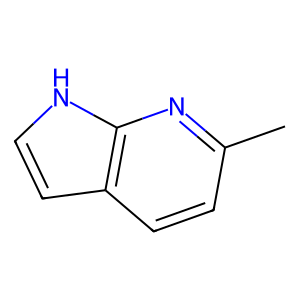
![structure of 6-Methyl-1h-pyrrolo[2,3-b]pyridine-3-carbaldehyde](https://molwiki.oss-cn-hongkong.aliyuncs.com/structure/26/1000340-26-0.svg)
6-Methyl-1h-pyrrolo[2,3-b]pyridine-3-carbaldehyde
Names and Identifiers of 1000340-26-0
CAS Number |
1000340-26-0 |
|---|---|
MDL Number |
MFCD09880114 |
IUPAC Name |
6-methyl-1H-pyrrolo[2,3-b]pyridine-3-carbaldehyde |
InChI |
InChI=1S/C9H8N2O/c1-6-2-3-8-7(5-12)4-10-9(8)11-6/h2-5H,1H3,(H,10,11) |
InChIKey |
HWZMDMUDEGMGME-UHFFFAOYSA-N |
Canonical SMILES |
CC1=NC2=C(C=C1)C(=CN2)C=O |
UNSPSC Code |
12352100 |
Physical and chemical properties of 1000340-26-0
Density |
1.3±0.1 g/cm3 |
|---|---|
Exact Mass |
160.063660 |
H Bond Acceptors |
2 |
H Bond Donors |
1 |
Index of Refraction |
1.712 |
LogP |
1.67 |
Molecular Formula |
C9H8N2O |
Molecular Weight |
160.173 |
PSA |
45.75000 |
Storage condition |
2-8°C |
Safety Information of 1000340-26-0

Applications of 1000340-26-0
6-Methyl-1H-pyrrolo[2,3-b]pyridine-3-carbaldehyde has potential applications in various fields:
- Pharmaceutical Development: Due to its possible biological activities, it may serve as a lead compound for developing new drugs.
- Chemical Research: It is valuable in synthetic organic chemistry for exploring new synthetic routes and methodologies.
- Material Science: Its unique structure might find applications in developing novel materials or catalysts.
The compound's versatility makes it an interesting candidate for further exploration in these domains.
Interaction Studies of 1000340-26-0
Interaction studies involving 6-Methyl-1H-pyrrolo[2,3-b]pyridine-3-carbaldehyde are essential for understanding its biological effects and potential drug interactions. Initial studies suggest that:
- Receptor Binding: The compound may interact with specific receptors in biological systems, influencing pathways related to neurotransmission or cellular signaling.
- Enzyme Inhibition: Investigations into its ability to inhibit enzymes could reveal mechanisms behind its antimicrobial or anticancer activities.
These studies will aid in determining safety profiles and therapeutic windows for future applications.
Biological Activity of 1000340-26-0
The biological activity of 6-Methyl-1H-pyrrolo[2,3-b]pyridine-3-carbaldehyde is an area of growing interest. Preliminary studies suggest potential applications in pharmacology due to its structural resemblance to biologically active compounds. It may exhibit:
- Antimicrobial Properties: Similar compounds have shown efficacy against various bacterial strains.
- Anticancer Activity: Some derivatives have been studied for their ability to inhibit cancer cell proliferation.
- Neuroprotective Effects: Research indicates that related structures could offer neuroprotective benefits, potentially aiding in conditions like Alzheimer's disease.
Further investigation is required to fully elucidate its biological mechanisms and therapeutic potential.
 Cas:824-51-1
