![structure of 3-Bromo-6-methyl-1H-pyrrolo[2,3-b]pyridine](https://molwiki.oss-cn-hongkong.aliyuncs.com/structure/28/1000340-28-2.svg)
3-Bromo-6-methyl-1H-pyrrolo[2,3-b]pyridine
Names and Identifiers of 1000340-28-2
CAS Number |
1000340-28-2 |
|---|---|
MDL Number |
MFCD09880116 |
IUPAC Name |
3-bromo-6-methyl-1H-pyrrolo[2,3-b]pyridine |
InChI |
InChI=1S/C8H7BrN2/c1-5-2-3-6-7(9)4-10-8(6)11-5/h2-4H,1H3,(H,10,11) |
InChIKey |
UUTGWFNTKXWYKP-UHFFFAOYSA-N |
Canonical SMILES |
CC1=NC2=C(C=C1)C(=CN2)Br |
UNSPSC Code |
12352100 |
Physical and chemical properties of 1000340-28-2
Density |
1.7±0.1 g/cm3 |
|---|---|
Exact Mass |
209.979248 |
Index of Refraction |
1.697 |
LogP |
3.26 |
Molecular Formula |
C8H7BrN2 |
Molecular Weight |
211.059 |
PSA |
28.68000 |
Storage condition |
2-8°C |
Safety Information of 1000340-28-2

Applications of 1000340-28-2
3-Bromo-6-methyl-1H-pyrrolo[2,3-b]pyridine has several applications:
- Pharmaceutical Development: Its role as an FGFR inhibitor positions it as a candidate for cancer therapies.
- Chemical Synthesis: The compound serves as an intermediate in the synthesis of more complex heterocyclic compounds.
- Biochemical Research: It is used in studies investigating FGFR signaling pathways and their implications in tumorigenesis.
Interaction Studies of 1000340-28-2
Studies have demonstrated that 3-Bromo-6-methyl-1H-pyrrolo[2,3-b]pyridine interacts with specific amino acid residues in FGFRs, forming hydrogen bonds that inhibit receptor activity. This interaction is crucial for its biological effects, particularly in cancer cell lines where it has been shown to disrupt cell signaling pathways essential for tumor growth and survival.
Biological Activity of 1000340-28-2
Research indicates that 3-Bromo-6-methyl-1H-pyrrolo[2,3-b]pyridine exhibits significant biological activity, particularly as an inhibitor of fibroblast growth factor receptors (FGFRs). Abnormal activation of FGFR signaling pathways is implicated in various cancers, making this compound a target for therapeutic intervention. Studies have shown that it can inhibit cell proliferation and induce apoptosis in cancer cell lines, such as breast cancer cells.
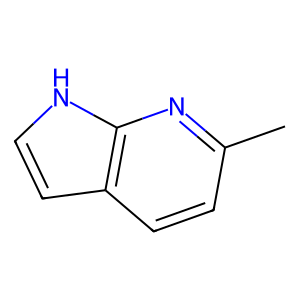 Cas:824-51-1

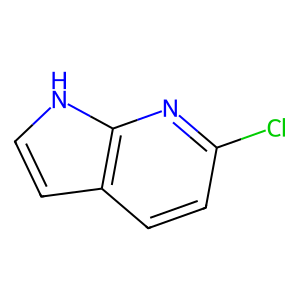 Cas:55052-27-2
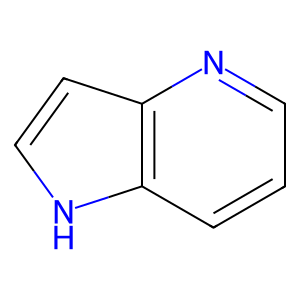 Cas:272-49-1