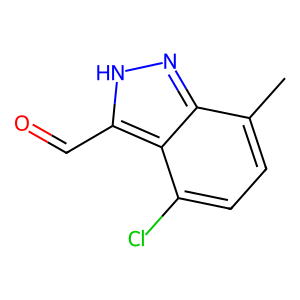
4-Chloro-7-methyl-1H-indazole-3-carbaldehyde
CAS No.:
1000340-67-9
M. Wt:
194.618
M. Fa:
C9H7ClN2O
InChI Key:
ZXDYFDLFHVNOOI-UHFFFAOYSA-N
Names and Identifiers of 1000340-67-9
CAS Number |
1000340-67-9 |
|---|---|
MDL Number |
MFCD09027041 |
IUPAC Name |
4-chloro-7-methyl-2H-indazole-3-carbaldehyde |
InChI |
InChI=1S/C9H7ClN2O/c1-5-2-3-6(10)8-7(4-13)11-12-9(5)8/h2-4H,1H3,(H,11,12) |
InChIKey |
ZXDYFDLFHVNOOI-UHFFFAOYSA-N |
Canonical SMILES |
CC1=CC=C(C2=C(NN=C12)C=O)Cl |
UNSPSC Code |
12352100 |
Physical and chemical properties of 1000340-67-9
Acidity coefficient |
11.26±0.40(Predicted) |
|---|---|
Boiling Point |
401.6±40.0 °C at 760 mmHg |
Density |
1.4±0.1 g/cm3 |
Exact Mass |
194.024689 |
Flash Point |
196.7±27.3 °C |
H Bond Acceptors |
2 |
H Bond Donors |
1 |
Index of Refraction |
1.716 |
LogP |
2.10 |
Molecular Formula |
C9H7ClN2O |
Molecular Weight |
194.618 |
PSA |
45.75000 |
Vapour Pressure |
0.0±0.9 mmHg at 25°C |
Safety Information of 1000340-67-9

Applications of 1000340-67-9
4-Chloro-7-methyl-1H-indazole-3-carbaldehyde has several potential applications:
- Pharmaceutical Development: Due to its biological activity, it is explored for developing new drugs targeting kinase pathways.
- Chemical Research: It serves as a building block for synthesizing other complex organic molecules.
Interaction Studies of 1000340-67-9
Studies on interaction mechanisms involving 4-Chloro-7-methyl-1H-indazole-3-carbaldehyde have revealed:
- Binding Affinity: Investigations into its binding affinity with specific kinases suggest that modifications on the indazole ring can significantly influence its inhibitory potency.
- Structure-Activity Relationship: Understanding how structural changes affect biological activity is crucial for optimizing drug candidates derived from this compound.
Biological Activity of 1000340-67-9
4-Chloro-7-methyl-1H-indazole-3-carbaldehyde and its derivatives have garnered attention for their biological activities. Indazole compounds are known to exhibit:
- Kinase Inhibition: Some indazole derivatives act as inhibitors for various kinases, which are critical in cancer and inflammatory diseases.
- Anti-inflammatory Properties: Certain studies suggest that indazole derivatives may possess anti-inflammatory effects, making them potential candidates for treating related disorders.