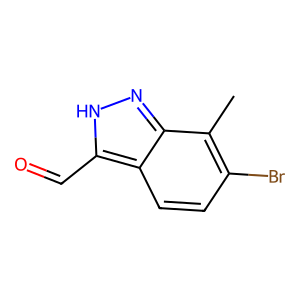
6-Bromo-7-methyl-1H-indazole-3-carbaldehyde
Names and Identifiers of 1000340-73-7
CAS Number |
1000340-73-7 |
|---|---|
EC Number |
816-923-4 |
MDL Number |
MFCD30365290 |
IUPAC Name |
6-bromo-7-methyl-2H-indazole-3-carbaldehyde |
InChI |
InChI=1S/C9H7BrN2O/c1-5-7(10)3-2-6-8(4-13)11-12-9(5)6/h2-4H,1H3,(H,11,12) |
InChIKey |
IBWRVJFENOQITQ-UHFFFAOYSA-N |
Canonical SMILES |
CC1=C(C=CC2=C(NN=C12)C=O)Br |
UNSPSC Code |
12352100 |
Physical and chemical properties of 1000340-73-7
Boiling Point |
420.0±40.0 °C at 760 mmHg |
|---|---|
Density |
1.7±0.1 g/cm3 |
Exact Mass |
237.974167 |
Flash Point |
207.8±27.3 °C |
H Bond Acceptors |
2 |
H Bond Donors |
1 |
Index of Refraction |
1.736 |
LogP |
2.27 |
Molecular Formula |
C9H7BrN2O |
Molecular Weight |
239.069 |
PSA |
45.75000 |
Vapour Pressure |
0.0±1.0 mmHg at 25°C |
Safety Information of 1000340-73-7

Applications of 1000340-73-7
6-Bromo-7-methyl-1H-indazole-3-carbaldehyde has several applications across different fields:
- Chemistry: It serves as a building block for the synthesis of more complex molecules and heterocyclic compounds.
- Biology: The compound is used in the study of enzyme inhibitors and receptor modulators.
- Pharmaceutical Industry: It has potential therapeutic applications due to its biological activity against cancer cells and other diseases.
- Material Science: Its unique properties make it useful in the development of new materials and chemical processes.
Interaction Studies of 1000340-73-7
Research continues to explore the interactions of 6-Bromo-7-methyl-1H-indazole-3-carbaldehyde with various biological targets. Studies have indicated that it can bind to specific enzymes or receptors, modulating their activity. For example, it may act as an inhibitor of certain kinases involved in cell signaling pathways. Further investigation into these interactions is essential to fully understand its biological implications and therapeutic potential.
Similar CompoundsSeveral compounds share structural similarities with 6-Bromo-7-methyl-1H-indazole-3-carbaldehyde. Notable examples include:
| Compound Name | Structural Features |
|---|---|
| 6-Bromo-1H-indazole-4-carboxaldehyde | Lacks the methyl group at the 7-position |
| 4-Bromo-7-methyl-1H-indazole-3-carbaldehyde | Contains a bromine atom at position 4 |
| 7-Methyl-1H-indazole-3-carbaldehyde | Lacks the bromine atom |
| 4-Chloro-7-methyl-1H-indazole-3-carbaldehyde | Contains a chlorine atom instead of bromine |
Biological Activity of 1000340-73-7
The biological activity of 6-Bromo-7-methyl-1H-indazole-3-carbaldehyde is significant due to its interaction with various biomolecules. It has been shown to act as an inhibitor or activator of specific enzymes, particularly protein kinases, which play crucial roles in cellular signaling and regulation. Indazole derivatives, including this compound, have been explored for their anticancer properties by inducing apoptosis in cancer cells through specific signaling pathways. Furthermore, it may influence cell function by altering gene expression and cellular metabolism.