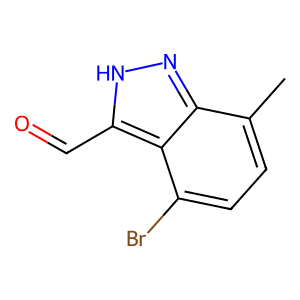
4-Bromo-7-methyl-1H-indazole-3-carbaldehyde
Names and Identifiers of 1000340-81-7
CAS Number |
1000340-81-7 |
|---|---|
IUPAC Name |
4-bromo-7-methyl-2H-indazole-3-carbaldehyde |
InChI |
InChI=1S/C9H7BrN2O/c1-5-2-3-6(10)8-7(4-13)11-12-9(5)8/h2-4H,1H3,(H,11,12) |
InChIKey |
JUURLZOFXNRLOT-UHFFFAOYSA-N |
Canonical SMILES |
CC1=CC=C(C2=C(NN=C12)C=O)Br |
Physical and chemical properties of 1000340-81-7
Boiling Point |
423.7±40.0 °C at 760 mmHg |
|---|---|
Density |
1.7±0.1 g/cm3 |
Exact Mass |
237.974167 |
Flash Point |
210.1±27.3 °C |
Index of Refraction |
1.736 |
LogP |
2.27 |
Molecular Formula |
C9H7BrN2O |
Molecular Weight |
239.069 |
PSA |
45.75000 |
Vapour Pressure |
0.0±1.0 mmHg at 25°C |
Applications of 1000340-81-7
4-Bromo-7-methyl-1H-indazole-3-carbaldehyde has several applications in medicinal chemistry:
- Kinase Inhibition: Its ability to inhibit specific kinases makes it a candidate for developing new anticancer therapies.
- Chemical Probes: This compound can serve as a chemical probe in biological studies to elucidate cellular mechanisms.
- Synthetic Intermediates: It can be used as an intermediate in synthesizing more complex indazole derivatives for pharmaceutical applications.
Interaction Studies of 1000340-81-7
Studies on the interaction of 4-Bromo-7-methyl-1H-indazole-3-carbaldehyde with various biomolecules indicate its potential as a selective inhibitor of certain kinases. These interactions may lead to alterations in cellular signaling pathways, providing insights into its mechanism of action and therapeutic potential. Further research is necessary to fully elucidate its interaction profiles and optimize its biological activity.
Biological Activity of 1000340-81-7
4-Bromo-7-methyl-1H-indazole-3-carbaldehyde exhibits significant biological activity, particularly as an inhibitor of various kinases involved in cell signaling pathways. Indazole derivatives have been reported to induce apoptosis in cancer cells, suggesting their potential as anticancer agents. Additionally, this compound may interact with various enzymes and proteins, influencing cellular processes such as gene expression and metabolism.
The unique combination of the bromine atom and the methyl group enhances its reactivity and selectivity, potentially leading to improved therapeutic effects compared to other indazole derivatives.