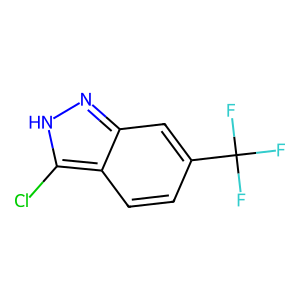
3-Chloro-6-(trifluoromethyl)-1H-indazole
Names and Identifiers of 1000341-24-1
CAS Number |
1000341-24-1 |
|---|---|
MDL Number |
MFCD09263229 |
IUPAC Name |
3-chloro-6-(trifluoromethyl)-2H-indazole |
InChI |
InChI=1S/C8H4ClF3N2/c9-7-5-2-1-4(8(10,11)12)3-6(5)13-14-7/h1-3H,(H,13,14) |
InChIKey |
DKBJSSGQCIDXNW-UHFFFAOYSA-N |
Canonical SMILES |
C1=CC2=C(NN=C2C=C1C(F)(F)F)Cl |
UNSPSC Code |
12352100 |
Physical and chemical properties of 1000341-24-1
Boiling Point |
305.8±37.0 °C at 760 mmHg |
|---|---|
Density |
1.6±0.1 g/cm3 |
Exact Mass |
220.001511 |
Flash Point |
138.7±26.5 °C |
H Bond Acceptors |
1 |
H Bond Donors |
1 |
Index of Refraction |
1.576 |
LogP |
3.29 |
Molecular Formula |
C8H4ClF3N2 |
Molecular Weight |
220.579 |
PSA |
28.68000 |
Vapour Pressure |
0.0±0.6 mmHg at 25°C |
Safety Information of 1000341-24-1

Applications of 1000341-24-1
The unique properties of 3-Chloro-6-(trifluoromethyl)-1H-indazole make it suitable for various applications:
- Pharmaceuticals: Its biological activity against cancer cell lines positions it as a potential lead compound in drug development.
- Agricultural Chemistry: The compound may also find applications in agrochemicals due to its structural similarity to other bioactive compounds.
- Material Science: The incorporation of trifluoromethyl groups often enhances thermal stability and hydrophobicity, making such compounds useful in material science applications.
Interaction Studies of 1000341-24-1
Studies have shown that 3-Chloro-6-(trifluoromethyl)-1H-indazole interacts with various biological targets, primarily through inhibition mechanisms that disrupt cellular processes in cancer cells. Understanding these interactions is crucial for elucidating its mechanism of action and optimizing its therapeutic potential.
Biological Activity of 1000341-24-1
Research indicates that 3-Chloro-6-(trifluoromethyl)-1H-indazole exhibits notable biological activity, particularly as an inhibitor against various cancer cell lines, including A549 (lung cancer) and BGC-823 (gastric cancer) cells. Its structural characteristics contribute to its potential as an anticancer agent, making it a subject of interest in medicinal chemistry.
Physical sample testing spectrum (NMR) of 1000341-24-1
