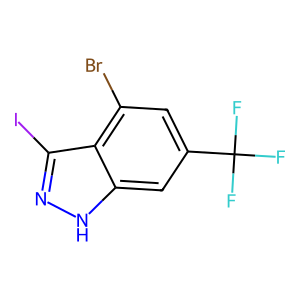
4-BROMO-3-IODO-6-(TRIFLUOROMETHYL) (1H)INDAZOLE
Names and Identifiers of 1000341-30-9
CAS Number |
1000341-30-9 |
|---|---|
MDL Number |
MFCD09263231 |
IUPAC Name |
4-bromo-3-iodo-6-(trifluoromethyl)-1H-indazole |
InChI |
InChI=1S/C8H3BrF3IN2/c9-4-1-3(8(10,11)12)2-5-6(4)7(13)15-14-5/h1-2H,(H,14,15) |
InChIKey |
IGOIJJKIDMAMMX-UHFFFAOYSA-N |
Canonical SMILES |
FC(F)(F)C1=CC(Br)=C2C(=C1)NN=C2I |
UNSPSC Code |
12352100 |
Physical and chemical properties of 1000341-30-9
Boiling Point |
387.1±37.0 °C at 760 mmHg |
|---|---|
Density |
2.3±0.1 g/cm3 |
Exact Mass |
389.847626 |
Flash Point |
187.9±26.5 °C |
H Bond Acceptors |
1 |
H Bond Donors |
1 |
Index of Refraction |
1.668 |
LogP |
4.19 |
Molecular Formula |
C8H3BrF3IN2 |
Molecular Weight |
390.927 |
PSA |
28.68000 |
Vapour Pressure |
0.0±0.9 mmHg at 25°C |
Safety Information of 1000341-30-9

Applications of 1000341-30-9
4-Bromo-3-iodo-6-(trifluoromethyl)-1H-indazole has several applications across different fields:
- Medicinal Chemistry: Serves as a precursor for synthesizing various pharmacologically active compounds.
- Biological Studies: Used to investigate enzyme inhibition and receptor interactions due to its unique structural features.
- Material Science: Explored for potential applications in developing novel materials with specific electronic and optical properties .
Interaction Studies of 1000341-30-9
Studies on the interactions of 4-Bromo-3-iodo-6-(trifluoromethyl)-1H-indazole with biological targets have revealed insights into its mechanism of action. The trifluoromethyl group enhances lipophilicity, allowing effective interaction with biological membranes. Additionally, the halogen atoms can participate in halogen bonding, influencing binding affinity towards various proteins .
Biological Activity of 1000341-30-9
The biological activity of 4-Bromo-3-iodo-6-(trifluoromethyl)-1H-indazole has been explored in various studies, particularly for its potential as an anticancer and antimicrobial agent. Its structural features allow it to interact with biological targets effectively, making it useful in enzyme inhibition studies and receptor binding assays .