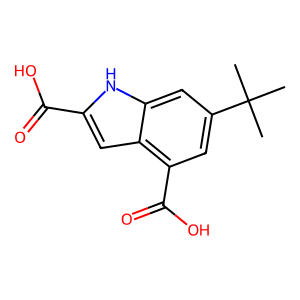
6-tert-butyl-1H-indole-2,4-dicarboxylic acid
Names and Identifiers of 1000341-47-8
CAS Number |
1000341-47-8 |
|---|---|
IUPAC Name |
6-tert-butyl-1H-indole-2,4-dicarboxylic acid |
InChI |
InChI=1S/C14H15NO4/c1-14(2,3)7-4-9(12(16)17)8-6-11(13(18)19)15-10(8)5-7/h4-6,15H,1-3H3,(H,16,17)(H,18,19) |
InChIKey |
LZKHMNSBBJJXST-UHFFFAOYSA-N |
Canonical SMILES |
CC(C)(C)C1=CC(=C2C=C(NC2=C1)C(=O)O)C(=O)O |
Physical and chemical properties of 1000341-47-8
Boiling Point |
532.3±50.0 °C at 760 mmHg |
|---|---|
Density |
1.3±0.1 g/cm3 |
Exact Mass |
261.100098 |
Flash Point |
275.7±30.1 °C |
Index of Refraction |
1.652 |
LogP |
3.67 |
Molecular Formula |
C14H15NO4 |
Molecular Weight |
261.273 |
PSA |
90.39000 |
Vapour Pressure |
0.0±1.5 mmHg at 25°C |
Applications of 1000341-47-8
6-tert-butyl-1H-indole-2,4-dicarboxylic acid has potential applications in various fields:
- Pharmaceuticals: As a precursor or active ingredient in drug formulations targeting oxidative stress-related diseases.
- Biochemistry: Used in research settings for studying metabolic pathways involving indoles.
- Agriculture: Potentially utilized as a plant growth regulator or pesticide due to its biological activity.
Interaction Studies of 1000341-47-8
Interaction studies of 6-tert-butyl-1H-indole-2,4-dicarboxylic acid focus on its binding affinity with various biological targets. Preliminary research indicates that it may interact with enzymes involved in oxidative stress pathways, suggesting a role in modulating cellular responses to stressors. Further studies are required to elucidate these interactions and their implications for therapeutic applications.
Biological Activity of 1000341-47-8
6-tert-butyl-1H-indole-2,4-dicarboxylic acid exhibits significant biological activity. It has been studied for its potential as an antioxidant and anti-inflammatory agent. Its structural similarity to other indole derivatives suggests that it may interact with biological pathways involving oxidative stress and inflammation. Additionally, compounds within the indole family are known for their roles in neurotransmission and as precursors to various biologically active molecules.