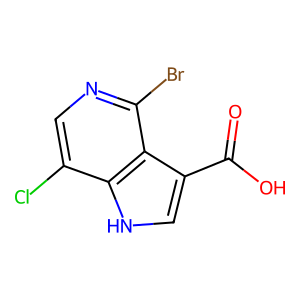
4-BROMO-7-CHLORO-5-AZAINDOLE-3-CARBOXYLIC ACID
CAS No.:
1000342-01-7
M. Wt:
275.487
M. Fa:
C8H4BrClN2O2
InChI Key:
-
Names and Identifiers of 1000342-01-7
CAS Number |
1000342-01-7 |
|---|---|
IUPAC Name |
4-bromanyl-7-chloranyl-1H-pyrrolo[3,2-c]pyridine-3-carboxylic acid |
Canonical SMILES |
C1=C(C2=C(N1)C(=CN=C2Br)Cl)C(=O)O |
Physical and chemical properties of 1000342-01-7
Acidity coefficient |
0.54±0.30(Predicted) |
|---|---|
Boiling Point |
524.0±45.0 °C at 760 mmHg |
Density |
2.0±0.1 g/cm3 |
Exact Mass |
273.914459 |
Flash Point |
270.7±28.7 °C |
Index of Refraction |
1.765 |
LogP |
2.59 |
Molecular Formula |
C8H4BrClN2O2 |
Molecular Weight |
275.487 |
PSA |
65.98000 |
Storage condition |
2-8°C |
Vapour Pressure |
0.0±1.4 mmHg at 25°C |
Applications of 1000342-01-7
4-Bromo-7-chloro-1H-pyrrolo[3,2-c]pyridine-3-carboxylic acid has several notable applications:
- Medicinal Chemistry: It serves as a building block for synthesizing potential therapeutic agents, particularly kinase inhibitors and other enzyme inhibitors.
- Biological Studies: The compound is utilized in research to explore its effects on cellular pathways and as a drug candidate.
- Chemical Biology: It functions as a probe in chemical biology studies to investigate protein-ligand interactions and enzyme mechanisms.
- Industrial
Biological Activity of 1000342-01-7
The biological activity of 4-Bromo-7-chloro-1H-pyrrolo[3,2-c]pyridine-3-carboxylic acid is an area of ongoing research. While specific targets have not yet been established, compounds with similar structures are known to influence various cellular processes. Potential biological effects include:
- Inhibition of Cell Proliferation: Similar compounds have demonstrated the ability to inhibit cell growth, suggesting potential applications in cancer therapy.
- Induction of Apoptosis: Some pyrrolopyridine derivatives are associated with triggering programmed cell death in malignant cells.
These activities indicate that 4-Bromo-7-chloro-1H-pyrrolo[3,2-c]pyridine-3-carboxylic acid could serve as a promising candidate for further pharmacological exploration.