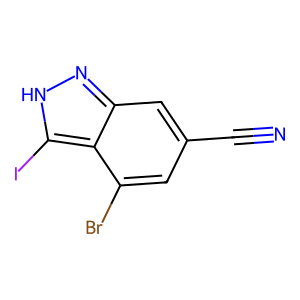
4-Bromo-3-iodo-1H-indazole-6-carbonitrile
Names and Identifiers of 1000342-48-2
CAS Number |
1000342-48-2 |
|---|---|
IUPAC Name |
4-bromo-3-iodo-2H-indazole-6-carbonitrile |
InChI |
InChI=1S/C8H3BrIN3/c9-5-1-4(3-11)2-6-7(5)8(10)13-12-6/h1-2H,(H,12,13) |
InChIKey |
QJAVJYWHXWCCIQ-UHFFFAOYSA-N |
Canonical SMILES |
C1=C(C=C(C2=C(NN=C21)I)Br)C#N |
Physical and chemical properties of 1000342-48-2
Acidity coefficient |
8.43±0.40(Predicted) |
|---|---|
Boiling Point |
469.9±40.0 °C at 760 mmHg |
Density |
2.5±0.1 g/cm3 |
Exact Mass |
346.855499 |
Flash Point |
238.0±27.3 °C |
Index of Refraction |
1.830 |
LogP |
3.07 |
Molecular Formula |
C8H3BrIN3 |
Molecular Weight |
347.938 |
PSA |
52.47000 |
Storage condition |
2-8°C |
Vapour Pressure |
0.0±1.2 mmHg at 25°C |
Applications of 1000342-48-2
4-Bromo-3-iodo-1H-indazole-6-carbonitrile finds applications in various fields:
- Medicinal Chemistry: As a building block for synthesizing pharmaceutical compounds with potential therapeutic effects.
- Material Science: Utilized in developing advanced materials such as organic semiconductors and light-emitting diodes (LEDs).
- Biological Research: Studied for its interactions with biological targets to understand its therapeutic potential.
Interaction Studies of 1000342-48-2
Research on interaction studies involving 4-Bromo-3-iodo-1H-indazole-6-carbonitrile focuses on its binding affinity and specificity toward various biological targets. These studies help elucidate the compound's mechanism of action and its potential therapeutic applications. Notably, its halogenated structure can influence its reactivity and interaction profile with proteins and enzymes.
Similar Compounds: ComparisonSeveral compounds share structural similarities with 4-Bromo-3-iodo-1H-indazole-6-carbonitrile. A comparison highlights its uniqueness:
| Compound Name | Key Differences |
|---|---|
| 6-Bromo-1H-indazole-4-carboxaldehyde | Different functional groups; lacks carbonitrile. |
| 1H-indazole-3-carboxaldehyde | Different functional group location; lacks halogens. |
| 1H-indazole-4-carboxylic acid | Different functional group location; lacks iodine. |
| 4-Bromo-6-fluoro-3-iodo-1H-indazole | Contains fluorine instead of carbonitrile; affects reactivity. |
Biological Activity of 1000342-48-2
Indazole derivatives, including 4-Bromo-3-iodo-1H-indazole-6-carbonitrile, exhibit a range of biological activities. They have been studied for their potential as:
- Anticancer Agents: Some derivatives show promising results in inhibiting cancer cell proliferation.
- Anti-inflammatory Compounds: Their ability to modulate inflammatory pathways has been explored.
- Antimicrobial Agents: Certain indazoles demonstrate activity against various microbial strains.
The mechanism of action often involves interaction with specific molecular targets such as enzymes and receptors, influenced by the compound's unique structural features.