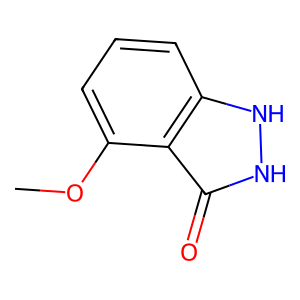
3H-Indazol-3-one, 1,2-dihydro-4-Methoxy-
Names and Identifiers of 1000342-89-1
CAS Number |
1000342-89-1 |
|---|---|
MDL Number |
MFCD13176928 |
IUPAC Name |
4-methoxy-2,3-dihydro-1H-indazol-3-one |
InChI |
InChI=1S/C8H8N2O2/c1-12-6-4-2-3-5-7(6)8(11)10-9-5/h2-4H,1H3,(H2,9,10,11) |
InChIKey |
BESHLNQIGLRLMG-UHFFFAOYSA-N |
Canonical SMILES |
COC1=CC=CC2=C1C(=O)NN2 |
UNSPSC Code |
12352100 |
Physical and chemical properties of 1000342-89-1
Boiling Point |
262.0±19.0 °C at 760 mmHg |
|---|---|
Density |
1.3±0.1 g/cm3 |
Exact Mass |
164.058578 |
Flash Point |
112.3±21.5 °C |
H Bond Acceptors |
3 |
H Bond Donors |
2 |
Index of Refraction |
1.565 |
LogP |
1.01 |
Molecular Formula |
C8H8N2O2 |
Molecular Weight |
164.161 |
PSA |
58.14000 |
Vapour Pressure |
0.0±0.5 mmHg at 25°C |
Safety Information of 1000342-89-1

Applications of 1000342-89-1
The applications of 4-Methoxy-1H-indazol-3(2H)-one span various fields:
- Medicinal Chemistry: Its enzyme inhibition properties make it a candidate for drug development targeting neurological disorders and cancer.
- Material Science: The compound's unique structural features allow for potential applications in organic electronics and photonic devices due to its electronic properties.
Interaction Studies of 1000342-89-1
Interaction studies involving 4-Methoxy-1H-indazol-3(2H)-one have focused on its binding affinity to biological targets. These studies often utilize computational methods alongside experimental techniques like surface plasmon resonance to measure binding interactions with target enzymes. The findings suggest that the compound interacts favorably with specific active sites, enhancing its potential as a therapeutic agent.
Biological Activity of 1000342-89-1
4-Methoxy-1H-indazol-3(2H)-one exhibits significant biological activity, particularly in inhibiting key enzymes. Research has indicated its potential as an inhibitor of monoamine oxidase B and nitric oxide synthase, which are crucial in neurological and cardiovascular functions. Additionally, derivatives of indazoles have shown promising antitumor activities, suggesting that this compound may have applications in cancer therapy.