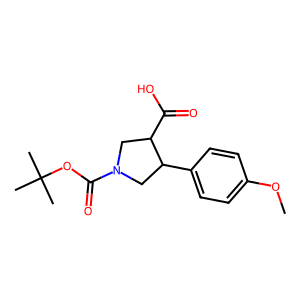
1-(tert-Butoxycarbonyl)-4-(4-methoxyphenyl)pyrrolidine-3-carboxylic acid
CAS No.:
1000415-75-7
M. Wt:
321.36800
M. Fa:
C17H23NO5
InChI Key:
ISEHHCOIDMZBSU-UONOGXRCSA-N
Appearance:
White To Off-White Solid
Names and Identifiers of 1000415-75-7
CAS Number |
1000415-75-7 |
|---|---|
MDL Number |
MFCD02089476 |
IUPAC Name |
(3S,4R)-4-(4-methoxyphenyl)-1-[(2-methylpropan-2-yl)oxycarbonyl]pyrrolidine-3-carboxylic acid |
InChI |
InChI=1S/C17H23NO5/c1-17(2,3)23-16(21)18-9-13(14(10-18)15(19)20)11-5-7-12(22-4)8-6-11/h5-8,13-14H,9-10H2,1-4H3,(H,19,20)/t13-,14+/m0/s1 |
InChIKey |
ISEHHCOIDMZBSU-UONOGXRCSA-N |
Canonical SMILES |
CC(C)(C)OC(=O)N1CC(C(C1)C(=O)O)C2=CC=C(C=C2)OC |
Isomeric SMILES |
CC(C)(C)OC(=O)N1C[C@H]([C@@H](C1)C(=O)O)C2=CC=C(C=C2)OC |
UNSPSC Code |
12352100 |
Physical and chemical properties of 1000415-75-7
Acidity coefficient |
4.33±0.40(Predicted) |
|---|---|
Boiling Point |
474.6±45.0 °C(Predicted) |
Density |
1.201±0.06 g/cm3(Predicted) |
Exact Mass |
321.15800 |
LogP |
2.66820 |
Molecular Formula |
C17H23NO5 |
Molecular Weight |
321.36800 |
PSA |
76.07000 |
Storage condition |
2-8℃ |
Safety Information of 1000415-75-7

Applications of 1000415-75-7
Trans-1-Boc-3-carboxy-4-(4-methoxyphenyl)pyrrolidine has diverse applications, particularly in:
- Pharmaceutical Development: Its structure allows for modifications that can lead to new drug candidates.
- Research: Used in studies related to peptide synthesis and medicinal chemistry.
- Chemical Synthesis: Acts as an intermediate in the synthesis of other complex organic molecules.
Biological Activity of 1000415-75-7
While specific biological activities of trans-1-Boc-3-carboxy-4-(4-methoxyphenyl)pyrrolidine have not been extensively documented, compounds with similar structures often exhibit significant biological properties. The presence of the methoxy group may enhance lipophilicity, potentially improving bioavailability and cellular uptake. This compound's ability to form peptide bonds suggests potential applications in drug development targeting various biological pathways.
Physical sample testing spectrum (NMR) of 1000415-75-7
