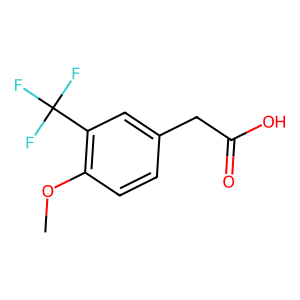
2-(4-Methoxy-3-(trifluoromethyl)phenyl)acetic acid
Names and Identifiers of 1000566-45-9
CAS Number |
1000566-45-9 |
|---|---|
MDL Number |
MFCD09832302 |
IUPAC Name |
2-[4-methoxy-3-(trifluoromethyl)phenyl]acetic acid |
InChI |
InChI=1S/C10H9F3O3/c1-16-8-3-2-6(5-9(14)15)4-7(8)10(11,12)13/h2-4H,5H2,1H3,(H,14,15) |
InChIKey |
SVJBALZZRCDJHL-UHFFFAOYSA-N |
Canonical SMILES |
COC1=C(C=C(C=C1)CC(=O)O)C(F)(F)F |
UNSPSC Code |
12352100 |
Physical and chemical properties of 1000566-45-9
Exact Mass |
234.05000 |
|---|---|
LogP |
2.34110 |
Melting Point |
103-106° |
Molecular Formula |
C10H9F3O3 |
Molecular Weight |
234.17200 |
PSA |
46.53000 |
Storage condition |
Sealed in dry,Room Temperature |
Safety Information of 1000566-45-9

Applications of 1000566-45-9
2-(4-Methoxy-3-(trifluoromethyl)phenyl)acetic acid finds applications primarily in pharmaceutical research due to its potential therapeutic properties. It may serve as an intermediate in the synthesis of bioactive compounds or as a lead structure for developing new drugs targeting inflammation or pain management.
Interaction Studies of 1000566-45-9
Interaction studies involving 2-(4-Methoxy-3-(trifluoromethyl)phenyl)acetic acid are essential to understand its pharmacodynamics and pharmacokinetics. Preliminary studies could include:
- Binding Affinity Tests: Evaluating interactions with specific receptors or enzymes.
- Metabolic Stability: Assessing how the compound is metabolized in biological systems.
- Toxicological Assessments: Determining any adverse effects associated with its use.
These studies are crucial for advancing its potential as a therapeutic agent.
Biological Activity of 1000566-45-9
Research indicates that compounds similar to 2-(4-Methoxy-3-(trifluoromethyl)phenyl)acetic acid exhibit anti-inflammatory and analgesic properties. While specific biological activity data for this compound is limited, the presence of the trifluoromethyl and methoxy groups suggests potential interactions with biological targets, possibly influencing metabolic pathways or receptor interactions. Further studies are necessary to establish definitive biological effects.
Physical sample testing spectrum (NMR) of 1000566-45-9
