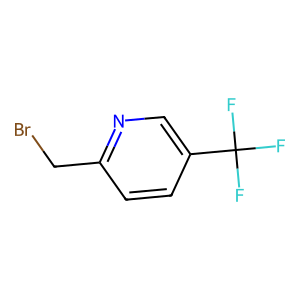
2-(Bromomethyl)-5-(trifluoromethyl)pyridine
Names and Identifiers of 1000773-62-5
CAS Number |
1000773-62-5 |
|---|---|
MDL Number |
MFCD11846578 |
IUPAC Name |
2-(bromomethyl)-5-(trifluoromethyl)pyridine |
InChI |
InChI=1S/C7H5BrF3N/c8-3-6-2-1-5(4-12-6)7(9,10)11/h1-2,4H,3H2 |
InChIKey |
UMXIAVUQROUXKO-UHFFFAOYSA-N |
Canonical SMILES |
C1=CC(=NC=C1C(F)(F)F)CBr |
UNSPSC Code |
12352100 |
Physical and chemical properties of 1000773-62-5
Boiling Point |
211.7±35.0 °C at 760 mmHg |
|---|---|
Density |
1.6±0.1 g/cm3 |
Exact Mass |
238.955734 |
Flash Point |
81.8±25.9 °C |
Index of Refraction |
1.488 |
LogP |
2.40 |
Molecular Formula |
C7H5BrF3N |
Molecular Weight |
240.020 |
PSA |
12.89000 |
Storage condition |
Inert atmosphere,Store in freezer, under -20°C |
Vapour Pressure |
0.3±0.4 mmHg at 25°C |
Safety Information of 1000773-62-5

Applications of 1000773-62-5
The applications of 2-(Bromomethyl)-5-(trifluoromethyl)pyridine are diverse:
- Organic Synthesis: It serves as an important intermediate for the synthesis of more complex organic molecules, particularly in pharmaceuticals and agrochemicals.
- Material Science: The compound may find applications in developing functional materials due to its unique electronic properties.
- Catalysis: It is utilized in various catalytic processes, especially those involving palladium catalysts.
Interaction Studies of 1000773-62-5
Interaction studies involving 2-(Bromomethyl)-5-(trifluoromethyl)pyridine primarily focus on its reactivity with different nucleophiles and its behavior in catalytic systems. The presence of both bromine and trifluoromethyl groups significantly influences its interaction profile, making it a versatile building block in organic synthesis.
Biological Activity of 1000773-62-5
While specific biological activities of 2-(Bromomethyl)-5-(trifluoromethyl)pyridine are not extensively documented, compounds with similar structures often exhibit interesting biological properties. For instance, trifluoromethylated pyridines are known to possess antimicrobial and anti-inflammatory activities. The electron-withdrawing nature of the trifluoromethyl group may enhance the lipophilicity and bioavailability of derivatives synthesized from this compound.
Physical sample testing spectrum (NMR) of 1000773-62-5

 Cas:31181-84-7
