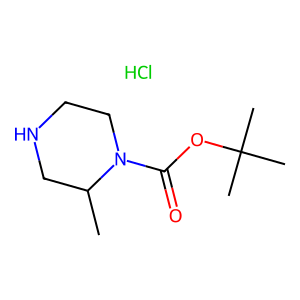
(R)-tert-butyl 2-methylpiperazine-1-carboxylate hydrochloride
Names and Identifiers of 1000853-53-1
CAS Number |
1000853-53-1 |
|---|---|
MDL Number |
MFCD11101216 |
IUPAC Name |
tert-butyl (2R)-2-methylpiperazine-1-carboxylate;hydrochloride |
InChI |
InChI=1S/C10H20N2O2.ClH/c1-8-7-11-5-6-12(8)9(13)14-10(2,3)4;/h8,11H,5-7H2,1-4H3;1H/t8-;/m1./s1 |
InChIKey |
CAKKNXNGNSFBHG-DDWIOCJRSA-N |
Canonical SMILES |
CC1CNCCN1C(=O)OC(C)(C)C.Cl |
Isomeric SMILES |
C[C@@H]1CNCCN1C(=O)OC(C)(C)C.Cl |
UNSPSC Code |
12352100 |
Physical and chemical properties of 1000853-53-1
Exact Mass |
236.129150 |
|---|---|
LogP |
2.28390 |
Molecular Formula |
C10H21ClN2O2 |
Molecular Weight |
236.739 |
PSA |
41.57000 |
Storage condition |
under inert gas (nitrogen or Argon) at 2-8°C |
Safety Information of 1000853-53-1

Applications of 1000853-53-1
(R)-tert-butyl 2-methylpiperazine-1-carboxylate hydrochloride has various applications in:
- Medicinal Chemistry: As a building block for synthesizing pharmaceutical compounds.
- Biochemical Research: In studies investigating receptor interactions and enzyme activities.
- Chemical Synthesis: As an intermediate in organic synthesis processes due to its reactive functional groups.
Interaction Studies of 1000853-53-1
Interaction studies involving (R)-tert-butyl 2-methylpiperazine-1-carboxylate hydrochloride focus on its binding affinity to various receptors and enzymes. These studies help elucidate its pharmacological potential and mechanisms of action. Techniques such as radiolabeled ligand binding assays and molecular docking simulations are commonly employed to assess these interactions.
Biological Activity of 1000853-53-1
The biological activity of (R)-tert-butyl 2-methylpiperazine-1-carboxylate hydrochloride is primarily attributed to its interaction with specific molecular targets such as receptors and enzymes. The piperazine ring enables the formation of hydrogen bonds and other interactions that can modulate receptor activity. Depending on the target, this compound may function as an agonist or antagonist, demonstrating potential in pharmacological research.
Physical sample testing spectrum (NMR) of 1000853-53-1
