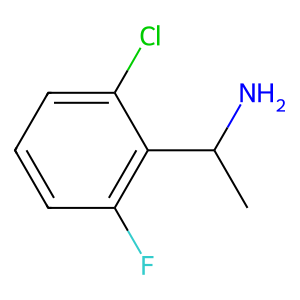
(S)-1-(2-Chloro-6-fluorophenyl)ethanamine
Names and Identifiers of 1000922-53-1
CAS Number |
1000922-53-1 |
|---|---|
MDL Number |
MFCD06761973 |
IUPAC Name |
(1S)-1-(2-chloro-6-fluorophenyl)ethanamine |
InChI |
InChI=1S/C8H9ClFN/c1-5(11)8-6(9)3-2-4-7(8)10/h2-5H,11H2,1H3/t5-/m0/s1 |
InChIKey |
WLQXZWHHERXWHA-YFKPBYRVSA-N |
Canonical SMILES |
CC(C1=C(C=CC=C1Cl)F)N |
Isomeric SMILES |
C[C@@H](C1=C(C=CC=C1Cl)F)N |
UNSPSC Code |
12352100 |
Physical and chemical properties of 1000922-53-1
Exact Mass |
173.04100 |
|---|---|
LogP |
3.19910 |
Molecular Formula |
C8H9ClFN |
Molecular Weight |
173.61500 |
PSA |
26.02000 |
Safety Information of 1000922-53-1

Applications of 1000922-53-1
(S)-1-(2-Chloro-6-fluorophenyl)ethanamine has potential applications in:
- Pharmaceutical Development: As a lead compound for developing new drugs targeting neurological disorders.
- Research: In studying receptor interactions and drug design due to its unique structural properties.
- Chemical Synthesis: As an intermediate in synthesizing more complex organic compounds.
Interaction Studies of 1000922-53-1
Interaction studies have demonstrated that (S)-1-(2-Chloro-6-fluorophenyl)ethanamine interacts with various receptors, particularly serotonin receptors. Its fluorine atom enhances hydrogen bonding interactions, which may stabilize receptor-ligand complexes. These interactions are crucial for understanding its pharmacodynamics and optimizing its therapeutic profile.
Biological Activity of 1000922-53-1
This compound exhibits significant biological activity, particularly in the context of neuropharmacology. It has been studied for its potential as a serotonin receptor modulator and shows promise in influencing neurotransmitter systems. The presence of both the chlorine and fluorine atoms enhances its binding affinity to certain receptors, making it a subject of interest in medicinal chemistry.
Physical sample testing spectrum (NMR) of 1000922-53-1

 Cas:87327-69-3
