![structure of tert-butyl N-[(2,4-dimethoxyphenyl)methyl]carbamate](https://molwiki.oss-cn-hongkong.aliyuncs.com/structure/01/1001181-01-6.svg)
tert-butyl N-[(2,4-dimethoxyphenyl)methyl]carbamate
CAS No.:
1001181-01-6
M. Wt:
267.32100
M. Fa:
C14H21NO4
InChI Key:
CJFXJAIZVMXYRB-UHFFFAOYSA-N
Appearance:
White Solid
Names and Identifiers of 1001181-01-6
CAS Number |
1001181-01-6 |
|---|---|
MDL Number |
MFCD21106254 |
IUPAC Name |
tert-butyl N-[(2,4-dimethoxyphenyl)methyl]carbamate |
InChI |
InChI=1S/C14H21NO4/c1-14(2,3)19-13(16)15-9-10-6-7-11(17-4)8-12(10)18-5/h6-8H,9H2,1-5H3,(H,15,16) |
InChIKey |
CJFXJAIZVMXYRB-UHFFFAOYSA-N |
Canonical SMILES |
COC1=CC=C(CNC(=O)OC(C)(C)C)C(OC)=C1 |
UNSPSC Code |
12352100 |
Physical and chemical properties of 1001181-01-6
Exact Mass |
267.14700 |
|---|---|
H Bond Acceptors |
3 |
H Bond Donors |
1 |
LogP |
3.11940 |
Molecular Formula |
C14H21NO4 |
Molecular Weight |
267.32100 |
PSA |
56.79000 |
Safety Information of 1001181-01-6

Applications of 1001181-01-6
Tert-butyl N-[(2,4-dimethoxyphenyl)methyl]carbamate finds applications in:
- Organic Synthesis: As an intermediate for synthesizing more complex organic molecules.
- Pharmaceutical Development: Potential use in drug formulation due to its biological activity.
- Agricultural Chemistry: Investigated for use in pesticide formulations owing to its stability and reactivity.
Interaction Studies of 1001181-01-6
Interaction studies involving tert-butyl N-[(2,4-dimethoxyphenyl)methyl]carbamate are necessary to understand its potential biological effects. Preliminary studies suggest that compounds with similar structures may interact with various enzymes or receptors. Further research is required to elucidate the specific interactions and mechanisms of action.
Physical sample testing spectrum (NMR) of 1001181-01-6

 Cas:18278-34-7

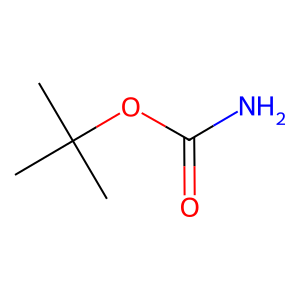 Cas:4248-19-5
