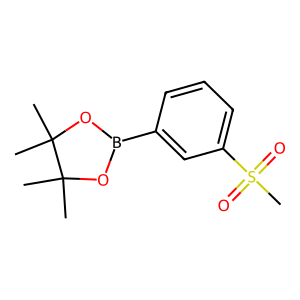
4,4,5,5-Tetramethyl-2-(3-(methylsulfonyl)phenyl)-1,3,2-dioxaborolane
Names and Identifiers of 1001185-88-1
CAS Number |
1001185-88-1 |
|---|---|
EC Number |
833-161-8 |
MDL Number |
MFCD14584690 |
IUPAC Name |
4,4,5,5-tetramethyl-2-(3-methylsulfonylphenyl)-1,3,2-dioxaborolane |
InChI |
InChI=1S/C13H19BO4S/c1-12(2)13(3,4)18-14(17-12)10-7-6-8-11(9-10)19(5,15)16/h6-9H,1-5H3 |
InChIKey |
UERYNIKUFOCEAB-UHFFFAOYSA-N |
Canonical SMILES |
B1(OC(C(O1)(C)C)(C)C)C2=CC(=CC=C2)S(=O)(=O)C |
UNSPSC Code |
12352100 |
Physical and chemical properties of 1001185-88-1
Boiling Point |
440.5±37.0 °C at 760 mmHg |
|---|---|
Density |
1.2±0.1 g/cm3 |
Exact Mass |
282.109711 |
Flash Point |
220.2±26.5 °C |
Index of Refraction |
1.518 |
LogP |
2.47010 |
Molecular Formula |
C13H19BO4S |
Molecular Weight |
282.164 |
PSA |
60.98000 |
Storage condition |
2-8°C |
Vapour Pressure |
0.0±1.0 mmHg at 25°C |
Safety Information of 1001185-88-1

Applications of 1001185-88-1
4,4,5,5-Tetramethyl-2-(3-(methylsulfonyl)phenyl)-1,3,2-dioxaborolane has several applications:
- Organic Synthesis: It serves as a versatile building block in organic synthesis due to its ability to form stable carbon-boron bonds.
- Material Science: The compound can be used in the development of new materials with specific electronic properties.
- Pharmaceutical Chemistry: Its reactivity makes it valuable for the synthesis of complex pharmaceutical compounds.
Interaction Studies of 1001185-88-1
Interaction studies involving this compound focus on its reactivity with various substrates in palladium-catalyzed reactions. These studies help elucidate the mechanisms behind its participation in C-H borylation and Suzuki-Miyaura coupling processes. Understanding these interactions can lead to optimized reaction conditions and improved yields in synthetic applications.
Biological Activity of 1001185-88-1
While specific biological activity data for 4,4,5,5-Tetramethyl-2-(3-(methylsulfonyl)phenyl)-1,3,2-dioxaborolane is limited, compounds with similar structures often exhibit significant biological properties. For instance, boron-containing compounds have been studied for their potential anticancer activities and roles in drug delivery systems. The methylsulfonyl group may also impart properties that enhance biological interactions.
Physical sample testing spectrum (NMR) of 1001185-88-1
