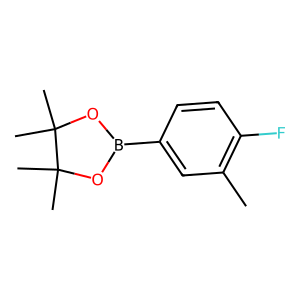
2-(4-Fluoro-3-methylphenyl)-4,4,5,5-tetramethyl-1,3,2-dioxaborolane
Names and Identifiers of 1001200-60-7
CAS Number |
1001200-60-7 |
|---|---|
EC Number |
941-103-9 |
MDL Number |
MFCD18729904 |
IUPAC Name |
2-(4-fluoro-3-methylphenyl)-4,4,5,5-tetramethyl-1,3,2-dioxaborolane |
InChI |
InChI=1S/C13H18BFO2/c1-9-8-10(6-7-11(9)15)14-16-12(2,3)13(4,5)17-14/h6-8H,1-5H3 |
InChIKey |
UNTVLIKQVDPHFS-UHFFFAOYSA-N |
Canonical SMILES |
B1(OC(C(O1)(C)C)(C)C)C2=CC(=C(C=C2)F)C |
UNSPSC Code |
12352100 |
Physical and chemical properties of 1001200-60-7
Boiling Point |
303.4±35.0℃(Predicted) |
|---|---|
Density |
1.04g/ml |
Exact Mass |
236.13800 |
LogP |
2.43330 |
Molecular Formula |
C13H18BFO2 |
Molecular Weight |
236.09000 |
PSA |
18.46000 |
Storage condition |
2-8°C |
Safety Information of 1001200-60-7

Applications of 1001200-60-7
The compound has several applications across various fields:
- Organic Synthesis: It serves as a crucial intermediate in the synthesis of complex organic molecules through cross-coupling reactions.
- Material Science: Its unique properties may be harnessed in developing new materials with specific functionalities.
- Pharmaceuticals: Potential applications in drug discovery and development due to its biological activity profile.
Interaction Studies of 1001200-60-7
To understand how 2-(4-Fluoro-3-methylphenyl)-4,4,5,5-tetramethyl-1,3,2-dioxaborolane interacts with biomolecules or surfaces, various analytical techniques can be employed:
- Nuclear Magnetic Resonance (NMR) Spectroscopy: Useful for determining molecular conformations and interactions.
- Mass Spectrometry (MS): Provides information on molecular weight and structure.
- Fourier Transform Infrared (FTIR) Spectroscopy: Helps identify functional groups and bonding patterns within the molecule.
Computational modeling tools such as Density Functional Theory (DFT) simulations can also predict interaction energies with potential binding partners.
Biological Activity of 1001200-60-7
While specific data on the biological activities of 2-(4-Fluoro-3-methylphenyl)-4,4,5,5-tetramethyl-1,3,2-dioxaborolane is limited, organoboron compounds are known for their potential therapeutic effects. Some derivatives have shown anti-inflammatory properties and may also play roles in cancer treatment by modulating cellular signaling pathways. Further studies are necessary to elucidate the precise biological mechanisms and potential applications of this specific compound.
Physical sample testing spectrum (NMR) of 1001200-60-7
