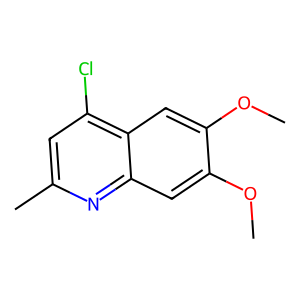
4-Chloro-6,7-dimethoxy-2-methylquinoline
CAS No.:
100122-02-9
M. Wt:
237.68200
M. Fa:
C12H12ClNO2
InChI Key:
RBFMLSFDCICSHW-UHFFFAOYSA-N
Appearance:
Off white solid
Names and Identifiers of 100122-02-9
CAS Number |
100122-02-9 |
|---|---|
MDL Number |
MFCD11868302 |
IUPAC Name |
4-chloro-6,7-dimethoxy-2-methylquinoline |
InChI |
InChI=1S/C12H12ClNO2/c1-7-4-9(13)8-5-11(15-2)12(16-3)6-10(8)14-7/h4-6H,1-3H3 |
InChIKey |
RBFMLSFDCICSHW-UHFFFAOYSA-N |
Canonical SMILES |
CC1=CC(=C2C=C(C(=CC2=N1)OC)OC)Cl |
UNSPSC Code |
12352100 |
Physical and chemical properties of 100122-02-9
Exact Mass |
237.05600 |
|---|---|
H Bond Acceptors |
3 |
H Bond Donors |
0 |
LogP |
3.21380 |
Molecular Formula |
C12H12ClNO2 |
Molecular Weight |
237.68200 |
PSA |
31.35000 |
Storage condition |
under inert gas (nitrogen or Argon) at 2-8°C |
Safety Information of 100122-02-9

Applications of 100122-02-9
The applications of 4-chloro-6,7-dimethoxy-2-methylquinoline span various fields:
- Pharmaceutical Development: Due to its biological activity, it is being explored for use in developing new anticancer and antimicrobial drugs.
- Chemical Research: It serves as a versatile building block for synthesizing other quinoline derivatives and studying their properties.
Interaction Studies of 100122-02-9
Interaction studies have revealed that 4-chloro-6,7-dimethoxy-2-methylquinoline interacts with various biological targets:
- Enzyme Inhibition: It has been shown to inhibit certain kinases associated with cancer progression.
- Binding Affinity: The compound demonstrates significant binding affinity to target proteins involved in metabolic pathways relevant to disease states.
Biological Activity of 100122-02-9
Research indicates that 4-chloro-6,7-dimethoxy-2-methylquinoline possesses significant biological activities, including:
- Anticancer Properties: It has shown potential as an inhibitor of certain cancer cell lines, particularly through its interaction with specific enzymes involved in tumor growth.
- Antimicrobial Activity: The compound exhibits antimicrobial properties against various bacterial strains, making it a candidate for further pharmaceutical development.
Physical sample testing spectrum (NMR) of 100122-02-9
