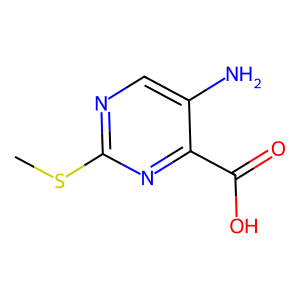
5-Amino-2-(methylthio)pyrimidine-4-carboxylic acid
CAS No.:
100130-05-0
M. Wt:
185.204
M. Fa:
C6H7N3O2S
InChI Key:
NTEPDMJNOBYJHJ-UHFFFAOYSA-N
Appearance:
Yellow Solid
Names and Identifiers of 100130-05-0
CAS Number |
100130-05-0 |
|---|---|
MDL Number |
MFCD12407810 |
IUPAC Name |
5-amino-2-methylsulfanylpyrimidine-4-carboxylic acid |
InChI |
InChI=1S/C6H7N3O2S/c1-12-6-8-2-3(7)4(9-6)5(10)11/h2H,7H2,1H3,(H,10,11) |
InChIKey |
NTEPDMJNOBYJHJ-UHFFFAOYSA-N |
Canonical SMILES |
CSC1=NC=C(C(=N1)C(=O)O)N |
UNSPSC Code |
12352100 |
Physical and chemical properties of 100130-05-0
Acidity coefficient |
3.40±0.10(Predicted) |
|---|---|
Boiling Point |
435.0±30.0 °C at 760 mmHg |
Density |
1.5±0.1 g/cm3 |
Exact Mass |
185.025894 |
Flash Point |
216.9±24.6 °C |
Index of Refraction |
1.668 |
LogP |
2.18 |
Melting Point |
190-191.5℃ (decomposition) |
Molecular Formula |
C6H7N3O2S |
Molecular Weight |
185.204 |
PSA |
114.40000 |
Storage condition |
under inert gas (nitrogen or Argon) at 2–8 °C |
Vapour Pressure |
0.0±1.1 mmHg at 25°C |
Safety Information of 100130-05-0

Applications of 100130-05-0
5-Amino-2-(methylthio)pyrimidine-4-carboxylic acid has various applications in:
- Pharmaceutical Development: It is explored as a lead compound for designing new antimicrobial and antiviral agents.
- Biochemical Research: Utilized in studies investigating metabolic pathways and enzyme interactions.
- Agricultural Chemistry: Potential applications as a plant growth regulator or pesticide due to its biological activity against pathogens.
Interaction Studies of 100130-05-0
Interaction studies have highlighted the compound's potential in:
- Drug Interactions: Evaluating how it interacts with other pharmaceutical compounds to assess synergistic effects or antagonism.
- Biological Pathways: Investigating its role in cellular signaling pathways and metabolic processes, which could reveal new therapeutic targets.
Biological Activity of 100130-05-0
Research indicates that 5-Amino-2-(methylthio)pyrimidine-4-carboxylic acid exhibits significant biological activity, particularly in the context of:
- Antimicrobial Properties: It has shown effectiveness against certain bacterial strains, making it a candidate for antibiotic development.
- Antiviral Activity: Some studies suggest potential efficacy against viral infections, although more extensive research is needed to confirm these findings.
- Enzyme Inhibition: The compound may act as an inhibitor for specific enzymes involved in metabolic pathways, which could be beneficial in treating metabolic disorders.
Physical sample testing spectrum (NMR) of 100130-05-0

 Cas:50593-92-5


 Cas:7758-99-8