
(2S,4S)-4-Fluoropyrrolidine-2-carboxylic acid hydrochloride
Names and Identifiers of 1001354-51-3
CAS Number |
1001354-51-3 |
|---|---|
MDL Number |
MFCD19105591 |
IUPAC Name |
(2S,4S)-4-fluoropyrrolidine-2-carboxylic acid;hydrochloride |
InChI |
InChI=1S/C5H8FNO2.ClH/c6-3-1-4(5(8)9)7-2-3;/h3-4,7H,1-2H2,(H,8,9);1H/t3-,4-;/m0./s1 |
InChIKey |
UCWWFZQRLUCRFQ-MMALYQPHSA-N |
Canonical SMILES |
C1C(CNC1C(=O)O)F.Cl |
Isomeric SMILES |
C1[C@@H](CN[C@@H]1C(=O)O)F.Cl |
UNSPSC Code |
12352100 |
Physical and chemical properties of 1001354-51-3
Exact Mass |
169.030579 |
|---|---|
LogP |
0.90180 |
Molecular Formula |
C5H9ClFNO2 |
Molecular Weight |
169.582 |
PSA |
49.33000 |
Storage condition |
Inert atmosphere,Room Temperature |
Safety Information of 1001354-51-3

Applications of 1001354-51-3
The primary applications of (2S,4S)-4-Fluoropyrrolidine-2-carboxylic acid hydrochloride include:
- Pharmaceutical Development: As a selective inhibitor for Aurora A kinase, it is being explored for potential use in cancer treatment.
- Research Tool: Used in biochemical studies to understand kinase signaling pathways and their roles in cellular processes.
Interaction Studies of 1001354-51-3
Interaction studies have shown that (2S,4S)-4-Fluoropyrrolidine-2-carboxylic acid hydrochloride effectively binds to Aurora A kinase, inhibiting its activity. This inhibition can lead to cell cycle arrest and apoptosis in cancer cells. Further studies are required to explore its interactions with other proteins and pathways to fully understand its biological implications.
Biological Activity of 1001354-51-3
This compound has been identified as a potent and selective inhibitor of the Aurora A kinase, an enzyme involved in cell cycle regulation and mitosis. Inhibition of this kinase has potential implications in cancer therapy, as dysregulation of Aurora A is commonly associated with tumorigenesis. Studies indicate that (2S,4S)-4-fluoropyrrolidine-2-carboxylic acid hydrochloride selectively targets this enzyme without significantly affecting other kinases, showcasing its specificity and potential therapeutic benefits.
Physical sample testing spectrum (NMR) of 1001354-51-3

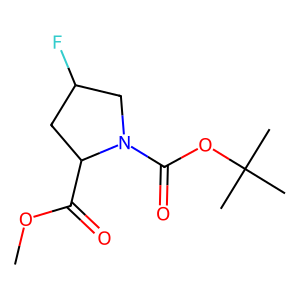 Cas:647857-39-4

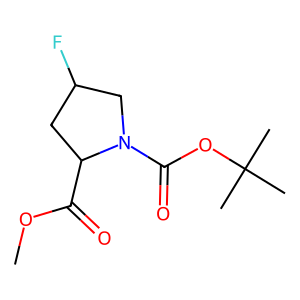 Cas:203866-16-4